
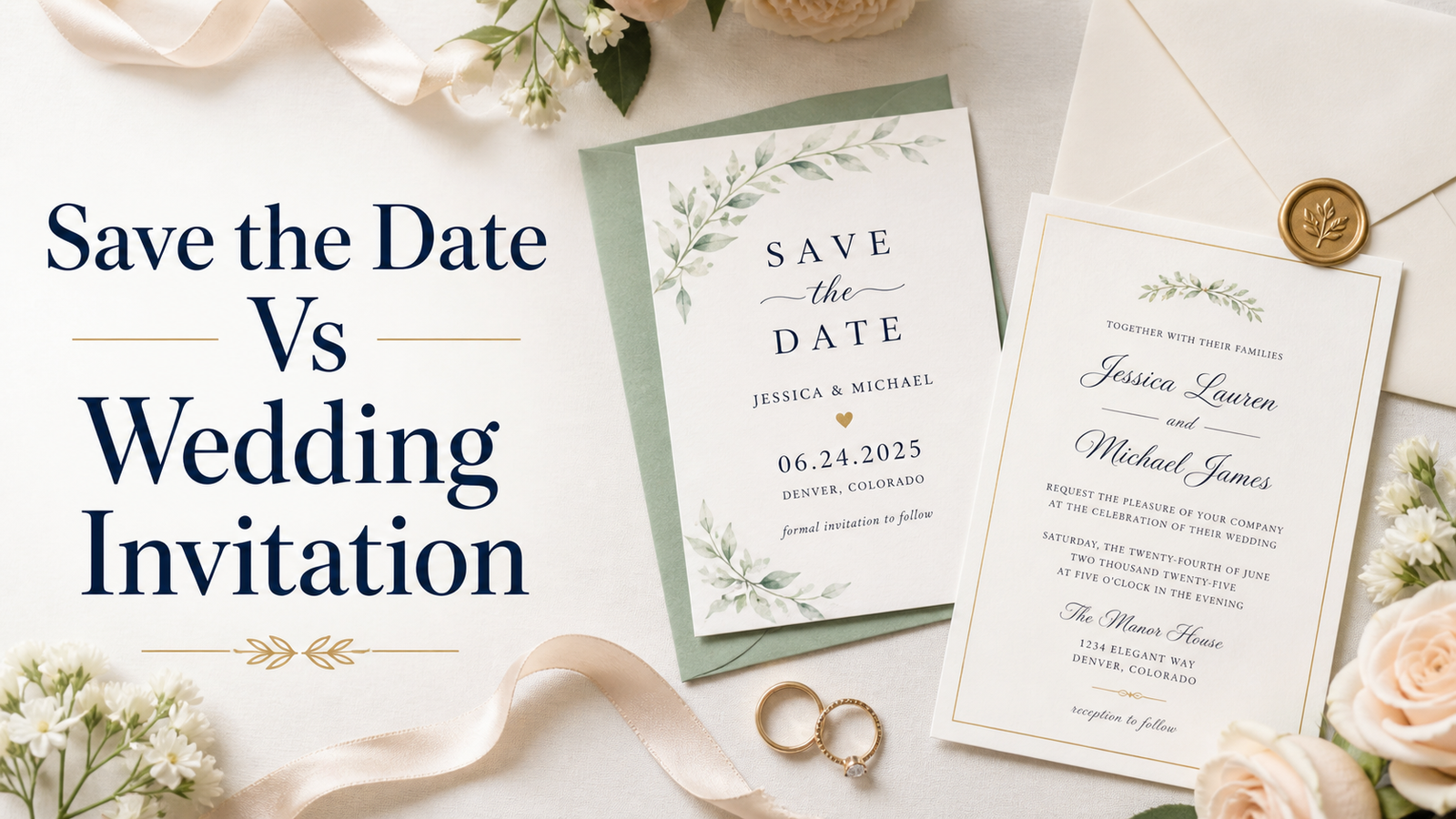
A save the date and a wedding invitation are not the same thing, even though both usually involve nice paper, envelopes, and at least one person asking, “Wait, do we really need both?” The short answer: a save the date tells guests to hold the date, while a wedding invitation formally invites them and gives them the details they need to attend.
For most weddings, the save the date goes out first, usually months before the invitation. The wedding invitation follows later, once the time, venue details, RSVP process, dress code, and event schedule are ready. If you are comparing Save the Date vs Wedding Invitation, think of the save the date as the early warning signal and the invitation as the official plan.
Quick Answer
A save the date is an early announcement. It tells guests the wedding date, general location, and sometimes the wedding website.
A wedding invitation is the formal invitation. It gives guests the ceremony details, reception information, RSVP deadline, dress code, and other practical instructions.
You can skip save the dates for a short engagement or very small local wedding. You should not skip wedding invitations unless you are doing a very casual digital-only event and have another clear RSVP system.
Save The Date Vs Wedding Invitation: The Main Difference
The easiest way to separate them is by purpose.
A save the date says:
“Please keep this date open. Formal invitation to follow.”
A wedding invitation says:
“You are invited. Here is where to go, when to arrive, what to wear, and how to RSVP.”
That difference matters because guests use each piece differently. A save the date helps them plan ahead, especially if they need to request time off, book flights, arrange childcare, or avoid scheduling another commitment. A wedding invitation helps them make the final decision and respond.
Save the dates are usually shorter, simpler, and more relaxed. Wedding invitations are more detailed and more formal.
What Is A Save The Date?
A save the date is the first printed or digital notice many guests receive about your wedding. It does not need to include every detail. In fact, it should not include every detail. Nobody needs a full weekend itinerary 11 months out unless you are running a destination wedding, and even then, breathe.
A typical save the date includes:
Couple’s names
Wedding date
City and state, or general location
Wedding website, if available
A short line like “Formal invitation to follow”
Save the dates can be postcards, flat cards, magnets, photo cards, or digital cards. They are often more playful than the formal invitation. This is where couples use engagement photos, casual wording, destination imagery, or a design style that hints at the wedding without locking in every detail.
What Is A Wedding Invitation?
A wedding invitation is the official invite to the ceremony and, when applicable, the reception. It gives guests the information they need to attend and respond.
A wedding invitation usually includes:
Couple’s names
Host names, if you are using formal wording
Wedding date
Ceremony time
Ceremony venue name and address
Reception details, if different
Dress code, if needed
RSVP deadline
RSVP method
Wedding website
Meal choices, if applicable
Details card or insert, if needed
Wedding invitations are more structured because guests need clear instructions. This is the piece where confusion gets expensive. A typo in the venue name, a missing RSVP deadline, or a vague start time can turn into a small administrative circus. And wedding planning already has plenty of circus energy without inviting more.
When To Send Save The Dates
For most weddings, send save the dates about 6 to 12 months before the wedding.
A more practical breakdown:
Local wedding with mostly local guests: 6 to 8 months before
Wedding with many out-of-town guests: 8 to 10 months before
Destination wedding: 9 to 12 months before
Holiday weekend wedding: 9 to 12 months before
Short engagement: skip save the dates and send invitations earlier
The goal is to give guests enough notice to protect the date. If travel is involved, earlier is better. Flights, hotels, time off, school calendars, and childcare do not magically arrange themselves because your envelope was pretty.
When To Send Wedding Invitations
For most weddings, send wedding invitations about 6 to 8 weeks before the wedding.
If many guests are traveling, sending invitations closer to 10 to 12 weeks before the wedding can make sense. For destination weddings, couples often send invitations earlier because guests need more time to finalize travel and lodging.
Your RSVP deadline should usually be about 3 to 4 weeks before the wedding, depending on when your caterer, venue, planner, or rental company needs the final count. Work backward from that date. The final headcount is not just a cute planning milestone. It affects meals, seating, rentals, favors, transportation, and the number of chairs that do not mysteriously appear by hope alone.
What To Include On A Save The Date
Keep your save the date simple. Its job is to reserve the date, not answer every possible question.
Include:
Your names
The wedding date
The city and state, or destination
Your wedding website, if it is ready
A note that a formal invitation will follow
You do not need to include:
Exact ceremony time
Full venue address, unless helpful
RSVP card
Meal choices
Registry details
Detailed dress code
Full weekend itinerary
If your wedding is destination-heavy, you can include more travel guidance on the wedding website. The save the date can point guests there without turning the card into a tiny travel brochure.
What To Include On A Wedding Invitation
The wedding invitation needs more information because guests are making a real commitment.
Include:
Who is getting married
Who is hosting, if you are using traditional wording
Date and time
Venue name and address
Reception information
RSVP deadline
RSVP method
Wedding website
Dress code, if needed
Depending on the wedding, you may also include:
Details card
Accommodations card
Directions card
Weekend schedule
Meal choice card
Reception card
Transportation information
Adults-only wording, handled carefully
QR code for RSVP or website
The invitation should be clear before it is clever. Beautiful wording is nice. But if your guests cannot figure out whether the ceremony starts at 4:00 or the reception starts at 4:00, the typography is not saving you.
Do You Need Both?
You do not always need both, but many couples should use both.
You should send save the dates if:
Many guests are traveling
The wedding is on a holiday weekend
The wedding is during a busy season
You are planning a destination wedding
Hotel rooms or flights may be limited
Guests need lots of notice for work or childcare
You want people to know the date before final details are ready
You can probably skip save the dates if:
You have a short engagement
Most guests are local
The wedding is small and informal
You are sending invitations very early
You are using digital communication and a wedding website effectively
Wedding invitations, though, are harder to skip. Even if you use digital invitations, guests still need a formal invitation and RSVP process. A group text is not a wedding invitation. It is a cry for help wearing casual shoes.
Printed Vs Digital Save The Dates
Printed save the dates feel more personal and are more likely to end up on a fridge, bulletin board, or kitchen counter. They are a good choice if you want a physical keepsake or if your wedding style leans traditional.
Digital save the dates are faster, cheaper, and easier to update. They work well for casual weddings, short timelines, or tech-comfortable guest lists. They can also be useful as a backup if you are sending printed cards but want to make sure people get the date quickly.
The downside of digital cards is that they are easier to miss. Emails get buried. Texts get forgotten. Spam folders are small dark caves where wedding details go to become myths.
Printed save the dates are not mandatory, but they do make the event feel more real to guests.
Printed Vs Digital Wedding Invitations
Printed wedding invitations still feel more formal. They also make sense when you care about paper quality, color, foil, letterpress, envelope addressing, or a coordinated invitation suite. A printed invitation sets the tone in a way a digital card usually cannot.
Digital invitations are useful when speed, budget, or RSVP tracking matters most. They can be easier for casual weddings, elopement celebrations, second receptions, or small events.
The best answer may be a hybrid. Send printed invitations to the main guest list, but use a wedding website or QR code for RSVPs, details, registry information, travel updates, and schedule changes. That gives you the physical feel without stuffing the envelope like it is preparing for a three-week expedition.
Design Differences
Save the dates can be more relaxed. They often use:
Engagement photos
Casual wording
Simple layouts
Destination graphics
Calendar-style designs
Magnets or postcards
Minimal details
Wedding invitations are usually more polished. They often use:
Formal typography
Coordinated paper stocks
Matching envelopes
RSVP cards
Details cards
Foil or letterpress
Premium finishes
More precise wording
The design does not have to match perfectly, but it should feel related. A save the date can be a teaser for the wedding style. The invitation should feel like the actual event.
If the save the date says relaxed mountain weekend and the invitation says black-tie ballroom in gold foil, guests may survive, but they will be confused.
Paper And Print Quality
Save the dates can usually be simpler and less expensive. A postcard or standard flat card is fine for most couples. Photo save the dates should have good color and enough paper weight to avoid feeling flimsy.
Wedding invitations deserve more attention. This is where paper weight, finish, color accuracy, trim quality, envelope quality, and proofing matter more. If you are ordering a full suite, check whether the printer offers matching RSVP cards, details cards, envelopes, address printing, foil, thicker stocks, or coating options.
In PrintReviewer’s invitation research, the strongest invitation printers tend to separate themselves through paper options, proofing, finishing choices, customer service, and turnaround reliability. Some companies are better for customization and templates. Others are better for premium paper, hard-copy proofs, or upload-your-own designs.
That is why the cheapest invitation is not always the best value. A wedding invitation has more ways to go wrong than a save the date. Wrong color, thin paper, late shipping, unclear proofing, or a clunky RSVP setup can create real stress.
Cost Differences
Save the dates are usually cheaper than wedding invitations because they are simpler. Many couples order a postcard, flat card, magnet, or digital version with fewer inserts and less formal finishing.
Wedding invitations cost more because they may include:
Invitation card
Envelope
RSVP card
RSVP envelope
Details card
Reception card
Envelope addressing
Premium stock
Foil or letterpress
Special shapes or cuts
Rush production or shipping
If you are trying to save money, keep the save the date simple and spend more of the budget on the invitation suite. Guests need the invitation details more than they need a luxury save the date.
A good budget-friendly approach:
Use a postcard save the date
Put travel info on the wedding website
Use a single details card instead of multiple inserts
Use online RSVPs
Skip unnecessary envelope liners
Choose one premium feature instead of five
Foil is lovely. Foil on every card, envelope, insert, and tiny decorative flourish is how stationery budgets start behaving like catering invoices.
Common Mistakes To Avoid
Sending save the dates before the guest list is final
Anyone who gets a save the date should also get an invitation. Do not send one casually and decide later. That is how wedding stationery becomes social dynamite.
Including too much information on the save the date
Keep it simple. Save the details for the invitation and wedding website.
Sending invitations too late
Guests need time to RSVP, book travel, choose outfits, arrange childcare, and remember where they put the envelope.
Forgetting the RSVP deadline
The RSVP deadline should be easy to find. Do not hide it in tiny script under a watercolor fern.
Using different guest lists
Your save the date list and invitation list should match unless there is a very specific and carefully handled reason.
Adding registry information directly to the invitation
It is usually cleaner to put registry information on the wedding website, not the main invitation.
Not ordering samples
Paper looks different in real life. Colors look different in print. If the invitation matters to you, order samples or a proof when possible.
Not proofreading names and addresses
This is the boring step that saves you from painful mistakes. Read everything out loud. Then have someone else read it too.
Save The Date Wording Examples
Simple and classic:
Save the Date
Emma Collins and James Walker
September 12, 2026
Park City, Utah
Formal invitation to follow
Casual:
We’re getting married
Emma and James
September 12, 2026
Park City, Utah
Details to come
Destination:
Save the Date
Emma and James are getting married
June 20, 2026
Maui, Hawaii
Travel details at our wedding website
Formal invitation to follow
Photo card:
Save our date
Emma + James
09.12.26
Park City, Utah
Invitation to follow
Wedding Invitation Wording Examples
Classic:
Together with their families
Emma Collins and James Walker
request the pleasure of your company
at their wedding celebration
Saturday, September twelfth
two thousand twenty-six
at four o’clock in the afternoon
Silver Lake Lodge
Park City, Utah
Reception to follow
Modern:
Emma Collins and James Walker
are getting married
Saturday, September 12, 2026
4:00 PM
Silver Lake Lodge
Park City, Utah
Dinner and dancing to follow
Casual:
Come celebrate with us
Emma and James
September 12, 2026
4:00 PM
Silver Lake Lodge
Park City, Utah
Reception, dinner, and dancing after
The save the date can be loose. The invitation should be precise.
Should The Save The Date Match The Wedding Invitation?
It can, but it does not have to.
Matching save the dates and wedding invitations create a polished look. This works especially well if you already know your wedding colors, fonts, venue style, and general design direction.
A looser match is also fine. Many couples send save the dates before every design decision is final. In that case, choose something that hints at the wedding style without painting you into a corner.
Good ways to connect both pieces:
Use the same color family
Use a similar font style
Use the same monogram
Use the same photo style
Use the same paper tone
Keep the formality level consistent
You do not need to make them identical. Just avoid making them look like they belong to two completely different weddings.
What About Wedding Websites?
Wedding websites are the bridge between save the dates and invitations.
Your save the date can include the wedding website so guests can check travel details, hotel blocks, registry information, FAQs, and schedule updates. Your invitation can also include the website, especially if you are collecting RSVPs online.
A website is especially useful for:
Destination weddings
Hotel room blocks
Weekend schedules
Dress code explanations
Registry information
Transportation details
Parking instructions
Kids or adults-only notes
Weather or venue updates
The printed pieces should stay clean. The website can carry the details that would make the invitation suite feel overstuffed.
Best Use Cases For Save The Dates
Save the dates are best for:
Destination weddings
Holiday weekend weddings
Summer weddings
Large weddings
Weddings with many out-of-town guests
Weddings in high-demand travel areas
Formal weddings with longer planning timelines
Couples who want a coordinated stationery suite
They are less necessary for:
Small local weddings
Short engagements
Casual courthouse celebrations
Events where invitations are going out very early
Best Use Cases For Wedding Invitations
Wedding invitations are best for every real wedding celebration, whether printed or digital.
They are especially important for:
Formal weddings
Venue-based weddings
Weddings with catering
Weddings with assigned seating
Events requiring RSVPs
Weddings with multiple locations
Weddings with dress codes
Weddings with travel details
Weddings where guests need clear timing
If guests need to RSVP, dress appropriately, show up at the right venue, and arrive at the right time, you need an invitation.
Final Verdict
When comparing Save the Date vs Wedding Invitation, the difference comes down to timing and purpose.
A save the date is the early heads-up. It tells guests the date, general location, and where to find more information. It helps people plan ahead, especially if travel is involved.
A wedding invitation is the formal invite. It gives guests the actual event details, RSVP instructions, venue information, and timing.
Most couples benefit from both, especially if the wedding involves travel, a large guest list, a destination, or a busy wedding season. But if your engagement is short or your wedding is small and local, you can skip save the dates and send invitations earlier.
If you are printing both, keep the save the date simple and spend more attention on the invitation suite. The save the date gets the date onto the calendar. The wedding invitation gets people to the right place, at the right time, hopefully wearing something close to the dress code.