
TLDR
For uprinting vs sttark roll labels, UPrinting is the clearer starting point for buyers who want a published 100-label entry quantity, multiple delivery formats, a 3-inch roll core, and eligible expedited production choices. Sttark is the more packaging-focused workflow when roll direction, hand-versus-machine application, roll diameter, specialty materials, foil, or spot gloss matter. Neither company can responsibly be named the universal price or quality winner without comparing the same size, material, finish, quantity, shipping destination, and proof requirements.
The practical decision is less about which logo appears on the box and more about whether the label specification fits your packaging line. Start with application method and environmental exposure, then compare proofs, production schedules, and the final delivered price. A cheap label that arrives wound incorrectly for an applicator—or uses the wrong adhesive for a cold container—is not good value.
The short answer: choose by workflow, not catalog size
Choose UPrinting first when you need a relatively small roll order, may want to switch between rolls, sheets, die-cut singles, and kiss-cut singles, or need to investigate an eligible one-, two-, or three-business-day production option. UPrinting lists roll labels starting at 100 units and says its rolls use a 3-inch core compatible with most standard applicators. Its catalog also covers paper, BOPP, vinyl, textured, metallic-looking, holographic, and removable options.
Choose Sttark first when the order is tightly connected to a packaging process. Its configurator asks whether labels will be applied by hand or machine and exposes controls for roll quantity, roll diameter, and unwind direction. Those fields can prevent production mistakes that are easy to miss when buying labels as if they were ordinary stickers. Sttark also lists options including white and clear plastics, white vinyl, paper, metallic plastic, soft-touch matte, foil, and spot gloss.
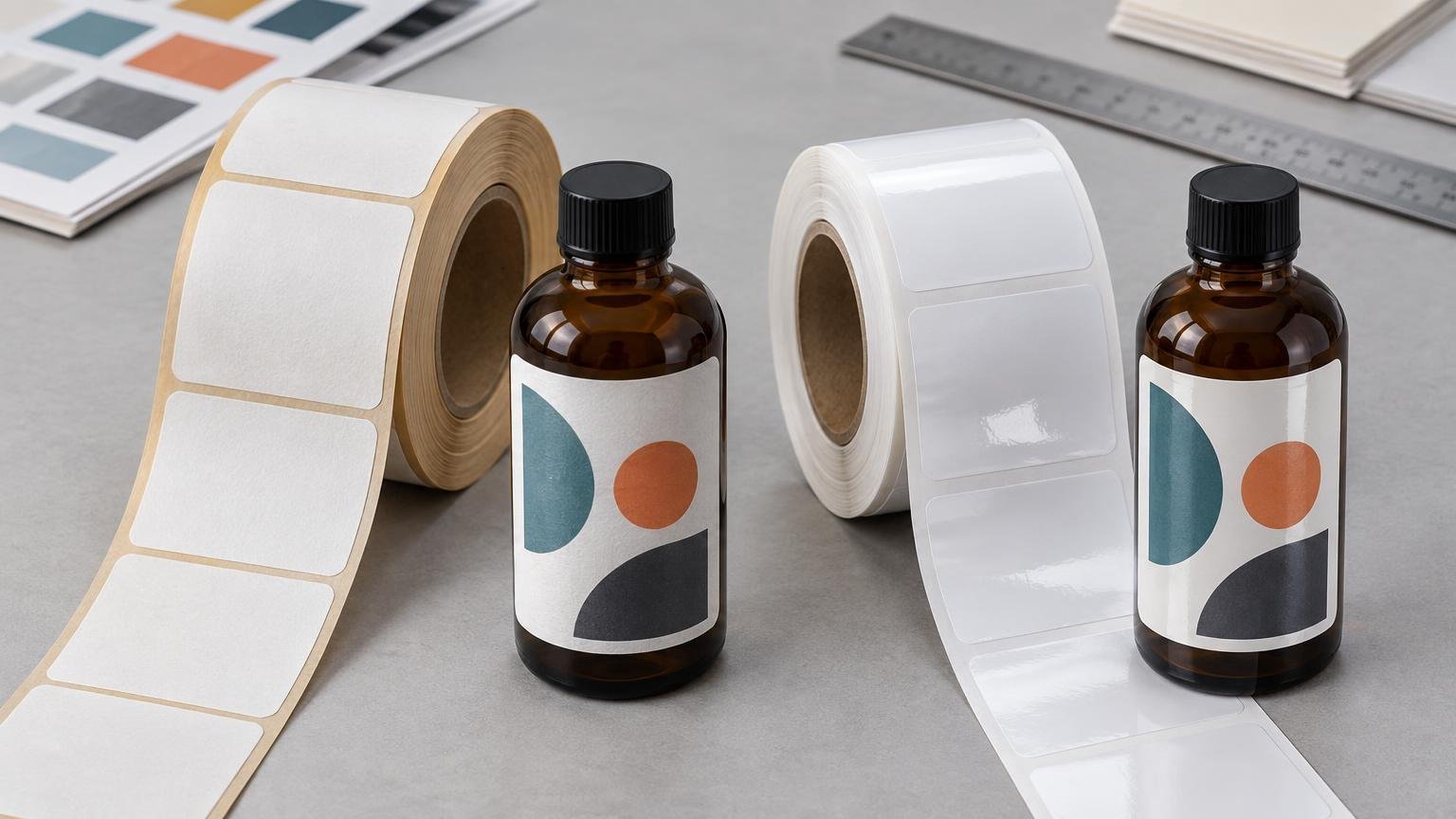
Those are workflow recommendations, not declarations about observed print quality. Although this project is identified as having comparable hands-on samples or orders, the supplied evidence packet does not include the exact configurations, dated photographs, invoices, or raw inspection notes. Specific claims about color, fine detail, cut registration, adhesion, defects, packaging, or delivery performance therefore cannot be attributed to the samples responsibly. PrintReviewer’s review methodology distinguishes direct observations from vendor specifications, and this comparison keeps that boundary visible.
UPrinting vs Sttark roll labels at a glance
| Decision factor | UPrinting | Sttark |
|---|---|---|
| Formats and workflow | Roll, sheet, die-cut single, and kiss-cut single labels; roll labels use a stated 3-inch core | Roll-focused configurator with hand or machine application, roll diameter, quantity, and unwind-direction controls |
| Listed materials | Paper, clear/white/silver BOPP, textured papers, white vinyl, holographic BOPP, and removable white BOPP | White and clear plastics, ultra-clear plastic, metallic plastic, paper, white vinyl, and Avon Classic Crest |
| Listed finishes | Gloss, matte, and soft touch | Gloss, UV gloss, matte, soft-touch matte, foil, and spot gloss |
| Proofing | PDF proof available; hard-copy proof also offered, although its stock differs from final production stock | Configuration and proof details should be confirmed for the exact order before payment |
| Entry point | Published starting quantity of 100 roll labels | Effective minimum spend should be confirmed in the live quote workflow |
| Production signals | Eligible configurations display one-, two-, or three-business-day production; custom shapes have a longer stated schedule | Configurator warns that a new die adds lead time starting at four days |
| Best initial fit | Smaller runs, multiple label formats, or eligible expedited production | Packaging workflows requiring detailed roll setup or specialty decoration |
Catalog names are not proof that two materials are equivalent. “White BOPP,” “white plastic,” and “vinyl” can differ in face-stock thickness, opacity, adhesive, liner, laminate, stiffness, and suitability for a particular container. A fair quote comparison requires each vendor to confirm the construction, not merely choose the closest-sounding menu item.
Materials: match the container and exposure
UPrinting lists premium sticker paper, white, clear, and silver BOPP, textured papers, white vinyl, holographic BOPP, and removable white BOPP. Sttark lists white paper, white and clear plastics, ultra-clear plastic, metallic plastic, white vinyl, and a textured Avon Classic Crest option. This gives both companies useful range, but the meaningful question is which construction fits the product.
Paper is usually the sensible place to begin for dry indoor packaging when tactile appearance and cost matter more than moisture resistance. Film-based materials are generally more appropriate when labels may encounter condensation, oils, or frequent handling. Vinyl can be useful for demanding surfaces or exposure, but paying for it is unnecessary when a protected paper label already meets the job.
UPrinting describes its BOPP and vinyl options as waterproof and oil-resistant and suggests them for some refrigerated products. Those are vendor-stated performance claims rather than results from a disclosed immersion, abrasion, freezer, or adhesive test. For refrigerated packaging, ask both vendors about the adhesive’s minimum application temperature and service-temperature range. Applying a label to a warm, dry container and later refrigerating it is not the same challenge as applying it to an already cold or damp surface.
If you are still deciding between substrates, the comparison of vinyl, BOPP, and paper labels explains how moisture, stiffness, surface shape, and expected use should affect the choice.
Finishes: appearance is only half the decision
UPrinting lists gloss, matte, and soft-touch finishes. Sttark lists gloss, UV gloss, matte, and soft-touch matte, with foil and spot-gloss options visible in its configurator. Sttark therefore presents more decorative controls in the cited workflow, but that does not automatically make it the better buy.
Gloss can increase visual contrast and gives many colors a more saturated appearance, but reflections can interfere with small text or barcode scanning under direct light. Matte reduces glare and often suits restrained packaging. Soft touch adds a distinctive hand feel, although it should earn its premium through the customer experience rather than being selected by default. Foil and spot gloss are most useful when they establish hierarchy around a logo, product name, or limited design element; covering too much of the label can weaken the effect and increase cost.
For any premium finish, request a representative production sample if color, texture, or shelf appearance is commercially important. A screen preview cannot show real reflectivity, surface drag, opacity, or the interaction between the finish and the chosen stock.
Roll setup can decide the comparison
Machine application changes the specification. Core diameter, maximum roll diameter, label gap, liner width, and unwind direction must fit the applicator. UPrinting states that its roll labels use a 3-inch core. Sttark’s configurator explicitly collects hand-or-machine application information and presents roll diameter and roll-direction choices.
For hand application, unwind direction may be mostly a convenience issue. For automatic application, the wrong orientation can make a finished roll unusable without rewinding it. Send the printer the applicator manufacturer’s requirements rather than relying on a verbal description such as “top first.” A dieline with clearly marked leading edge and copy orientation is safer.
Buyers who do not actually need rolls should also reconsider the format. Sheets can be easier to store and distribute for occasional manual labeling, while rolls generally support faster repetitive application and integration with dispensers. The roll labels versus sticker sheets guide covers that workflow decision in more detail.
Proofing: what each proof can and cannot establish
UPrinting offers PDF proofs and says an order does not enter the production queue until approval. It also offers hard-copy proofs but warns that the proof stock differs from the final production stock. That qualification matters: a hard-copy proof on substitute stock may help reveal artwork, scale, text, and layout problems, but it cannot fully validate final texture, opacity, adhesive behavior, or finished color appearance.
For Sttark, confirm the current proof type, price, and timing within the live quote or directly with support. A test-domain FAQ mentioned proof timing and an approximate minimum order value, but those details are not reliable enough to present as current live policy without confirmation.
Whichever vendor you choose, inspect the proof at final size and verify:
- Finished dimensions, shape, corner radius, bleed, and safe area
- Small text, fine reverse type, and thin lines at actual print size
- Barcode or QR-code size, contrast, and quiet zone
- White ink requirements for clear or metallic material
- Copy orientation and leading edge for machine application
- Core size, roll diameter, unwind direction, and labels per roll
- Material, adhesive, laminate or finish, and any specialty effect
- Whether proof approval starts the production clock
Turnaround and shipping are separate clocks
UPrinting displays one-, two-, and three-business-day production choices for eligible configurations and gives custom-shape labels a stated six-business-day printing turnaround. Availability depends on the selected configuration. Sttark’s configurator warns that producing a new die begins at four days of lead time. Neither statement is a delivery promise.
UPrinting explicitly distinguishes rush production from expedited shipping. It says shipping charges vary with package count or weight, destination ZIP code, and service level. The same underlying principle applies to any printer: production time ends when the order ships, while transit time begins after carrier pickup.
Build the schedule backward from the date labels must be applied, not the product launch date. Include time for artwork correction, proof review, production, carrier transit, incoming inspection, and a contingency day or two. If a missing label would stop fulfillment, paying for a faster production tier without protecting the proofing and transit stages provides incomplete deadline protection.
How to compare price and delivered value fairly
No defensible price winner can be named from the supplied evidence because there are no same-day matched carts for identical configurations and one destination. Advertised starting prices are especially weak comparison points: they may use different quantities, materials, sizes, shapes, or production schedules.
Create matched carts at the quantities you may realistically buy—100, 500, and 1,000 is a useful starting set where both workflows allow it. Keep size, shape, material class, finish, printed sides, proof type, production speed, and destination constant. Record the quote date because pricing and promotions change.
| Cost component | What to record | Why it matters |
|---|---|---|
| Merchandise | Price for the normalized label configuration | Establishes the comparable base cost |
| Die or setup | New-die, artwork, plate, or setup charge | Can dominate a short custom-shape run |
| Proof | Electronic or physical proof fee | A physical proof may add cost and schedule time |
| Production upgrade | Rush or expedited manufacturing charge | Must not be confused with faster carrier service |
| Shipping | Service, charge, and estimated transit | Can reverse the apparent base-price winner |
| Tax | Amount shown for the same destination | Needed for an actual checkout total |
| Delivered unit cost | All-in total divided by usable labels | Best simple measure for normalized value |
Also account for waste. Labels damaged during setup, supplied on an incompatible roll, or rejected after inspection increase the effective unit cost. Conversely, a more expensive configuration can be better value when it reduces hand-application time or works reliably with existing equipment.
Who should choose UPrinting?
UPrinting is the more straightforward first quote for a buyer who needs a 100-label starting quantity, wants access to several label delivery formats, or is searching for an eligible expedited production option. Its stated 3-inch roll core is also a useful published specification when matching an applicator.
It is not automatically the better option for every small order. Shipping, proof requirements, material upgrades, and custom-shape production can change both the total and the schedule. Confirm that the desired size and stock qualify for the production speed shown before building a deadline around it.
Who should choose Sttark?
Sttark deserves the first quote when labels are part of a defined packaging operation rather than an occasional sticker purchase. Its application method, roll diameter, roll quantity, and unwind controls make the workflow particularly relevant to machine-applied labels. Its listed foil, spot-gloss, metallic, ultra-clear, and textured choices also make it worth considering for packaging where decoration materially affects shelf presentation.
The tradeoff is that buyers should verify the effective live order minimum, proof schedule, new-die timing, and final shipping charge before committing. Sttark’s previous identity as Frontier Label may also appear in older discussions or records; the company states that it changed its name to Sttark in 2022.
What a decisive sample test should examine
A proper physical comparison should use equivalent materials where possible and document any unavoidable differences. The inspection should cover fine text, line sharpness, solid-fill consistency, color appearance under the same lighting, cut registration, edge condition, finish uniformity, liner release, application behavior, and visible defects. Barcodes and QR codes should be tested rather than judged by appearance alone.
Adhesion and resistance testing must reflect the intended package. Apply labels to the actual container after cleaning it in the normal production manner, then evaluate after an appropriate dwell period. Condensation, refrigeration, oil, abrasion, curved surfaces, and repeated handling should be introduced only when they resemble real use. Results from one stock and adhesive should not be generalized to every material in either catalog.
Bottom line
UPrinting currently has the clearer case for smaller published starting quantities, multiple label formats, a stated 3-inch core, and eligible faster production choices. Sttark has the clearer case for a roll-centered packaging workflow with detailed application controls and a broad set of decorative options. Those distinctions are supported by the vendors’ current product interfaces; they are not substitutes for matched samples or delivered-cost calculations.
Before ordering, request two normalized quotes and approve proofs using the same checklist. Let application compatibility eliminate unsuitable configurations first, then compare material construction, deadline risk, and delivered unit cost. For a broader shortlist, see PrintReviewer’s custom label printing companies guide. If neither workflow fits and the project can use a sticker-focused supplier, custom stickers and labels are another relevant category to compare. Disclosure: that linked alternative is an owned network property and is not one of the two vendors evaluated in this comparison.
References
- Custom Label Printing Services – Roll, Sheet & Cut-to-Size | UPrinting
- Product Label Printing – Custom Labels | UPrinting
- Custom Labels Instant Quote | Sttark
- Review Methodology – The Print Reviewer
- Shipping and Delivery – Support Center | UPrinting
- Sttark | Sttark