
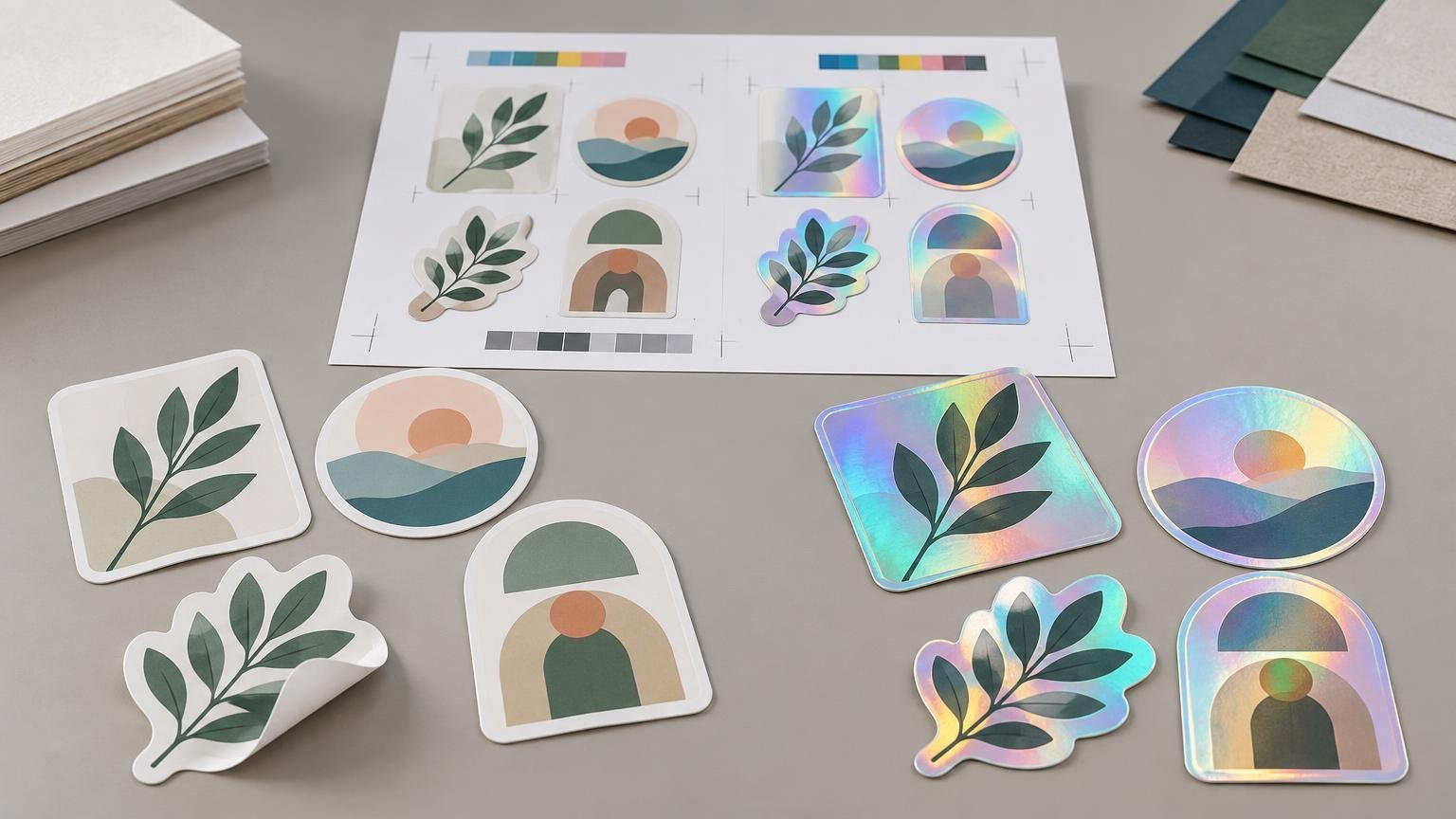
TLDR: In the CustomStickers vs StickerApp decision, StickerApp is the clearer starting point when a named specialty material such as holographic, mirror, glitter, brushed aluminum, prismatic, or Pixie Dust is central to the design. CustomStickers is compelling when you want standard die-cut vinyl, a clearly requestable proof workflow, or access to specialty sticker product categories beyond its standard offering. Neither company can be named the universal quality or price winner from the available evidence because the underlying matched sample records and equivalent live-cart totals are not available.
The practical answer is to compare equivalent stickers before comparing brands. Match the artwork, finished size, quantity, cut format, material, finish, proof requirement, shipping destination, and delivery speed. Default prices shown on the two websites use different configurations, so treating either displayed number as proof of better value would be misleading.
Quick chooser: CustomStickers or StickerApp?
| Buying priority | Better starting point | Why |
|---|---|---|
| Standard white die-cut vinyl with a formal proof request | CustomStickers | Its documented workflow lets the buyer request an online proof, receive revisions, or choose immediate printing. |
| A specific specialty effect | StickerApp | Its die-cut range identifies numerous effect materials directly, making it easier to begin with the desired visual treatment. |
| The smallest possible test order | Check both configurations | CustomStickers describes no minimum but may route quantities below its standard selector elsewhere; StickerApp minimums vary with size and material. |
| Lowest delivered price | Run matched carts | The supplied headline prices represent different sizes and quantities and cannot establish a price winner. |
| A hard event deadline | Compare complete schedules | Proof time, production time, transit, and contingency time all matter; a production estimate alone is not a delivery promise. |
| Proven physical-quality winner | No responsible winner yet | A defensible judgment requires identifiable, configuration-matched samples and test records. |
This is therefore a workflow-and-specification comparison, not a substitute for a normalized physical test. Buyers who want more context on the underlying cut formats can first review the difference between die-cut and kiss-cut stickers.
What is actually being compared?
The cleanest baseline is an individually cut, standard white sticker using the same artwork and approximately the same finished dimensions. Both providers can serve that basic job, but they present their options differently.
CustomStickers describes its standard custom vinyl stickers as individually die-cut and offers matte or gloss finishes. Its larger catalog also includes clear, holographic, glitter, crystal, heavy-duty, and glow sticker products. Buyers can examine those categories through CustomStickers’ custom-print storefront.
StickerApp offers several formats and organizes much of its die-cut selection around named materials. Its documented range includes white polypropylene vinyl plus effects such as holographic, mirror, glitter, brushed aluminum, prismatic, and Pixie Dust. Availability can depend on the format, material, and finish selected. The applicable combinations should be confirmed in StickerApp’s custom-sticker configurator rather than assumed from a general materials list.
That distinction does not prove that one provider prints better. It means StickerApp currently exposes a particularly broad, material-led specialty menu, while CustomStickers combines a conventional white-vinyl product with multiple specialty product categories. The better catalog depends on whether the buyer starts with a visual effect, a standard promotional sticker, or another functional requirement.
Materials and finishes: start with the intended appearance
For a basic logo, packaging insert, giveaway, or brand sticker, standard white material is usually the sensible comparison. White provides a predictable base beneath the ink and avoids the artwork adjustments that transparent, metallic, or sparkling substrates may require. A specialty material is worth paying for only when its effect remains visible in the finished design.
StickerApp deserves the first look when the substrate is part of the artwork. A holographic or mirror base can show through unprinted or selectively treated areas, while glitter and prismatic effects create a deliberately conspicuous result. The useful question is not which menu contains the most effects; it is whether the selected material works with the design’s white areas, fine details, contrast, and intended viewing conditions.
CustomStickers remains relevant for specialty work because its catalog includes several specialty categories of its own. However, buyers should compare the exact product pages rather than assume every effect shares the standard vinyl product’s finishes, minimums, production window, or performance claims. For a broader look at this buying decision, see PrintReviewer’s guide to alternatives for specialty sticker finishes.
CustomStickers markets its standard vinyl stickers as waterproof, dishwasher-safe, UV-laminated, and suitable for more than five years outdoors. Those are vendor-stated performance claims, not independent durability results established by the evidence available for this comparison. A long-term outdoor, dishwasher, or abrasion claim should not be converted into an observed result without a documented exposure test.
Proofing is the clearest workflow difference
CustomStickers lets the buyer request an online proof or choose immediate printing. Its published information says proofs normally arrive within one to two business days, revisions are free, and an unapproved proof automatically moves forward after three days.
That workflow provides a useful control point for artwork with a tight cutline, small text, borders, unusual transparency, or a placement that must be checked before production. The auto-approval rule is equally important: requesting a proof is not a reason to ignore subsequent messages. A buyer who misses the approval window could lose the chance to catch a problem.
StickerApp provides a digital preview in its editor, but that preview should not be treated as an automatically issued manual production proof. The supplied documentation says a manual proof should be requested in an order comment when one is needed. For simple artwork, the editor may be enough to place the order confidently. For a demanding cutline or specialty-material design, explicitly request human review and confirm how approval affects production timing.
On documented workflow alone, CustomStickers has the clearer proof proposition. StickerApp remains workable, but buyers should not assume that using the editor automatically creates the same review process.
Minimum quantities are configuration-specific
CustomStickers says custom stickers have no minimum quantity, but the observed standard product selector began at 50 pieces and directed buyers seeking fewer units to another product. That makes “no minimum” a catalog-level statement rather than proof that every material and ordering route accepts a one-piece order under identical terms.
StickerApp says it has low minimums, but the applicable minimum varies by size and material. A minimum observed for standard white material therefore should not be assumed to apply to holographic, glitter, mirror, or another specialty selection.
For a small test batch, configure the actual finished size and material on both sites. Also check whether the low-quantity option changes the construction, finish choices, shipping terms, or unit price. The smallest available order is useful for proof-of-concept work, but it is not automatically the best value.
Turnaround and shipping are separate clocks
CustomStickers’ supplied pages describe roughly two business days for printing or one to two business days of processing. Proofing can add time before that production stage begins. StickerApp says production typically takes one to two business days, while its shipping information describes normal total delivery as commonly taking three to seven business days, depending on region and shipping method.
Those estimates sound similar, but they do not guarantee equivalent arrival dates. A responsible deadline calculation separates artwork review, proof approval, production, carrier transit, weekends, holidays, and a contingency margin. PrintReviewer explains this distinction in more detail in its guide to production time versus shipping time.
CustomStickers’ standard product page states that U.S. economy shipping is free on orders over $35, although broader marketing language in the supplied material is less specific. StickerApp says standard shipping is free for orders to the United States, Canada, the European Union, and Japan, with express shipping priced at checkout. Both policies should be verified in the cart because the product, destination, order value, and speed can change the available service.
Why the displayed prices do not identify a winner
The supplied CustomStickers page showed $30.99 for a configuration involving 50 two-inch stickers. The supplied StickerApp page showed $27 for a 29-piece configuration. Those numbers are not a valid head-to-head price comparison: the quantities differ, and the complete material, finish, delivery, and promotional contexts are not normalized.
A useful price check should use the same artwork and a defined configuration—for example, a 3 × 3-inch individually die-cut sticker on the closest comparable standard white material. Price 50, 100, 250, and 500 units with the same finish, U.S. destination ZIP code, standard shipping, no coupon, and taxes shown separately.
- Record the merchandise subtotal before discounts.
- Identify setup, artwork, proof, or specialty-material charges.
- Record standard and expedited shipping separately.
- Note the promised production window and estimated delivery range.
- Calculate the pre-tax delivered total and delivered unit cost.
- Repeat the check on the same day because promotions and configurations can change.
This process may produce different winners at different quantities. A provider can be cheaper for a 50-piece test and more expensive at 500, or offer a lower base price that is erased by shipping. Delivered cost—not the first number visible on the product page—is the meaningful comparison.
What the available evidence cannot establish
No physical-quality winner is named in this version because a fair conclusion requires identifiable order and sample records. At minimum, the records need to show the artwork, dimensions, quantity, material, finish, cutline, proof choice, order date, shipping method, and evaluation date for each sample.
Without that normalization, differences in color, detail, laminate appearance, stiffness, backing, cut accuracy, peel behavior, packaging, or durability could come from the selected configuration rather than the provider. The same limitation applies to delivery and service claims: actual order, proof, dispatch, delivery, and support timestamps are needed before describing one experience as faster or easier.
PrintReviewer’s published methodology emphasizes evaluating real orders and received output, along with corrections and disclosure of relevant conflicts. Those methodology statements explain the standard, but they do not independently prove a result for this specific comparison. Readers looking specifically at CustomStickers can also consult the separate CustomStickers company review, while keeping its test configuration and date in mind.
Verdict by use case
Choose CustomStickers when proof control matters
CustomStickers is the stronger starting point for a standard die-cut order when you want a clearly described online proof, free revisions, and an explicit choice between proofing and immediate production. Remember that the proof can auto-approve after three days, and confirm the exact low-quantity route if ordering fewer than the standard selector permits.
Choose StickerApp when the material is the design feature
StickerApp is the more direct starting point for artwork built around a named effect such as holographic, mirror, glitter, brushed aluminum, prismatic, or Pixie Dust. Confirm that the desired finish, size, and format are available together, and request a manual proof rather than assuming the editor preview provides one.
Run matched carts when price is the deciding factor
There is no defensible price winner from the supplied default configurations. Compare pre-tax delivered totals for the same specifications and quantities. For repeat orders, save the configuration and note whether a temporary discount influenced the first purchase.
Treat a deadline as a risk calculation
Both providers publish relatively short production estimates, but neither should be selected for an immovable event solely from that headline. Include proofing, transit, and a buffer for correction or reprinting. If the deadline matters more than price, compare the checkout delivery estimates and document the selected service before paying.
The bottom line
The CustomStickers vs StickerApp choice is less about finding one universal winner and more about choosing the right workflow. Start with CustomStickers for a conventional die-cut vinyl order where a formal proof process is valuable. Start with StickerApp when a specific specialty substrate is central to the artwork.
Before ordering, build the same sticker on both sites and compare minimums, proof treatment, production time, shipping, and delivered cost. Until matched sample records support a physical-quality conclusion, treat claims about superior color, cutting, durability, packaging, or service as unresolved rather than filling the gap with marketing language.
References
- Custom Vinyl Stickers | Waterproof and Durable – CustomStickers.com
- Shop Stickers | Fast and Free Shipping – CustomStickers.com
- Custom Stickers | Make and Print Stickers Online | StickerApp
- stickerapp.com
- stickerapp.com
- customstickers.com
- How to create a sticker?
- stickerapp.com
- About Us – The Print Reviewer
- Editorial Policy – The Print Reviewer