
TLDR
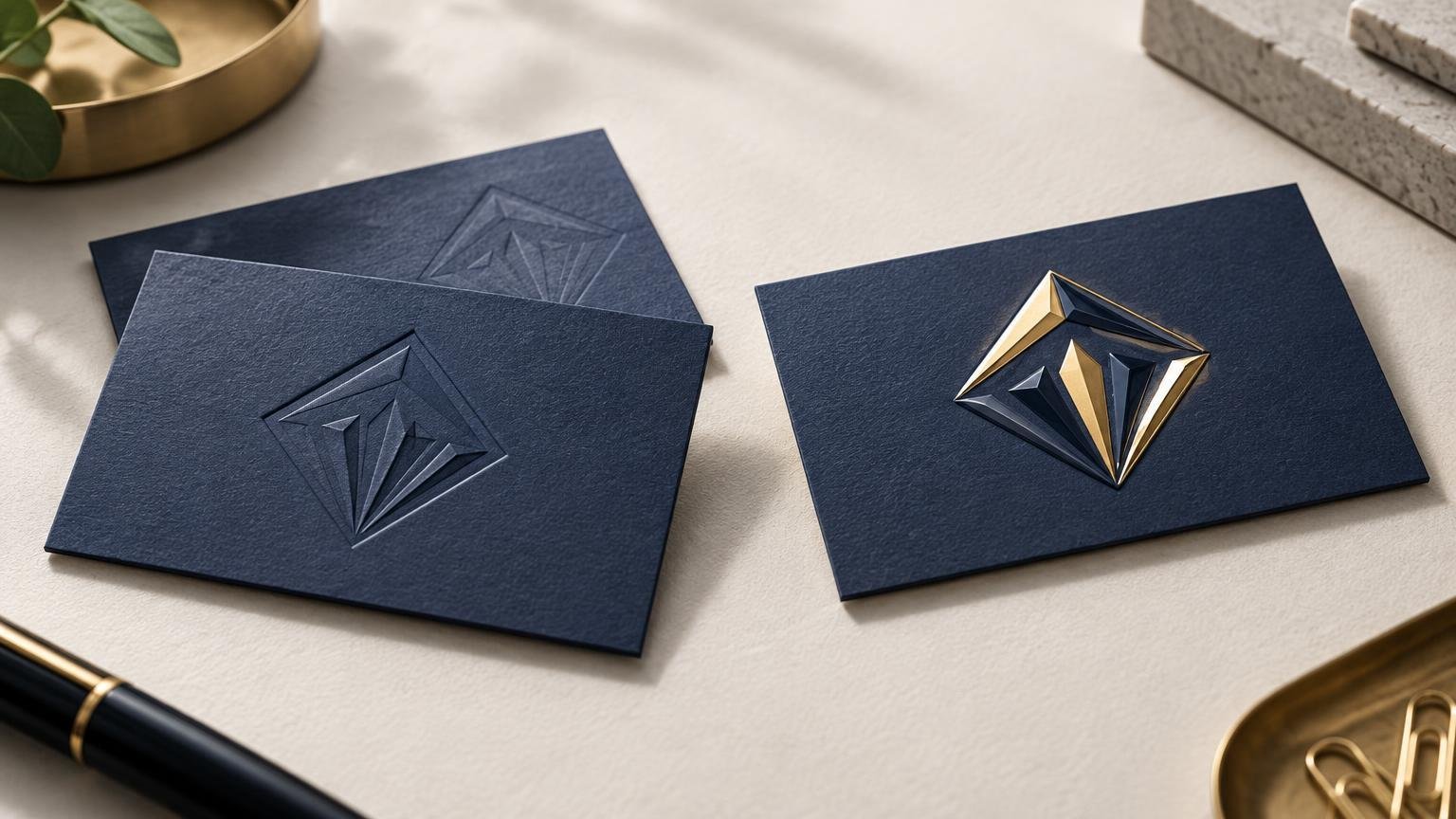
In embossing vs digital embellishment, the defining difference is physical construction. Conventional embossing uses matched tooling and pressure to form relief in the paper or board. Digital embellishment is a broader category of file-driven finishing processes that may deposit polymer or varnish, transfer foil, create texture, add gloss, or vary the decoration from one piece to another. It does not necessarily reshape the substrate.
Choose conventional embossing when the brief specifically requires the stock itself to be raised or recessed. Consider digital embellishment when you need decorative surface effects, short-run flexibility, versioning, or personalization that a particular system supports. Before comparing prices, ask the printer what creates the height, whether actual foil is transferred, whether the sheet is physically formed, and what appears on the reverse.
The terminology is the trap. “Digital embossing,” “3D foil,” and “raised foil” can describe materially different constructions. A product name is not enough to predict feel, reflectivity, reverse-side appearance, fold behavior, or durability. Get the production method in writing and approve a representative physical sample.
Embossing vs digital embellishment at a glance
| Question | Conventional embossing | Digital embellishment |
|---|---|---|
| What creates the effect? | Matched tooling and pressure physically form the substrate. | A file-driven system applies or transfers material, such as polymer, varnish, or foil, depending on the equipment. |
| Is the stock itself shaped? | Yes. Forming the sheet is the central mechanism. | Not necessarily. Many effects build relief on the surface instead. |
| Can it create a recessed effect? | Yes. Debossing presses the design into the surface. | A deposited effect normally builds above the surface; ask whether the offered system can produce any visually recessed simulation. |
| Can it include foil? | Foil is a separate operation that can be registered with embossing. | Some systems can apply foil as part of a digital workflow, but the construction varies. |
| Can every piece be different? | Conventional tooling generally repeats a fixed design. | Variable names, numbers, or graphics may be possible on suitably equipped systems. |
| What happens on the reverse? | The forming operation can affect the reverse, subject to tooling, stock, relief, and job design. | A surface-applied effect may leave the reverse visually unchanged, but this must be confirmed for the actual process. |
| What must the buyer verify? | Relief direction, die setup, stock compatibility, depth, registration, and reverse-side expectations. | Deposited material, actual foil transfer, achievable height, supported stocks, variable-data capability, and finishing limits. |
What conventional embossing actually does
Conventional paper embossing is a forming process. A relief die and corresponding counter-die bring the substrate into a three-dimensional shape under pressure. Embossing raises the intended area, while debossing creates a recessed impression. That physical displacement is what separates true embossing from a coating that merely sits above the sheet.
This distinction matters because formed paper behaves differently from deposited material. Relief may influence the reverse side, particularly when the design is deep, the stock is relatively thin, or both sides carry tightly registered content. The exact result depends on the stock, tooling, pressure, relief geometry, and the printer’s setup, so buyers should not infer a guaranteed reverse-side appearance from the word “embossed” alone.
Embossing can also be blind, meaning the relief is produced without ink or foil. Alternatively, it can be registered with printing or a separate foil-stamping operation. That means “foil plus embossing” is not automatically the same construction as a digitally produced raised-foil effect, even when the two look similar in an online photograph.
What digital embellishment can mean
Digital embellishment is a category rather than one universal process. The Foil & Specialty Effects Association presents it as part of print finishing and separately identifies routes including hot foil, cold foil, toner-based digital foil, and varnish-based digital foil. FSEA’s Digital Embellishment Alliance provides industry education around this category.
Depending on the system and supplier, a digital workflow may apply clear gloss, tactile texture, built-up polymer, foil, or combinations of these effects. Scodix, for example, describes its own technology as capable of placing polymer, building multilayer effects, adding foil within its workflow, and supporting variable-data enhancement. These are manufacturer-described capabilities of that technology, not proof that every digital embellishment vendor offers the same options or achieves the same result.
The practical attraction is file-driven control. A compatible workflow may change the embellished area between pieces without manufacturing a unique physical die for every design. That can be useful for numbered covers, individualized direct mail, localized packaging, or invitations with versioned decorative elements. Buyers exploring invitation printing options should still confirm whether personalization applies to the embellishment itself or only to the underlying printed text.
Digital does not automatically mean raised, metallic, personalized, faster, or cheaper. Those outcomes depend on the specified device, deposited material, coverage, run length, stock, sheet size, workflow, and supplier. The available evidence does not establish a universal cost or turnaround point at which digital embellishment beats conventional embossing.
Why “digital embossing” and “raised foil” need clarification
“Digital embossing” is often used commercially for a raised surface effect created without a conventional embossing die. That may be a useful description of how the result feels, but it does not prove that the paper fibers were physically formed between matched tools. If formed stock is essential to the design, ask that question directly.
“Raised foil” is similarly ambiguous. PrintReviewer’s related guide notes that it is not a standardized production description and recommends identifying both whether foil is transferred and what creates the raised profile. The comparison of spot UV, foil, and raised foil examines that terminology in a business-card context.
A quoted raised metallic effect could involve foil over built-up material, foil transferred within a varnish-based workflow, conventional foil registered with embossing, or another proprietary construction. A metallic-looking printed simulation is different again. If metallic reflection matters, confirm whether the job uses transferred foil rather than relying on a product label or screen rendering. The distinction between transferred foil and metallic ink is covered further in this foil versus metallic ink guide.
Gloss terminology can be just as loose. Flat spot varnish, raised clear material, and effects marketed as “3D” do not have the same profile. The spot UV versus raised UV comparison explains why coating height and feel need to be specified rather than assumed.
When conventional embossing is the better fit
Choose conventional embossing when physically formed stock is part of the design requirement. It is the clearer specification for a blind crest, recessed wordmark, tactile border, or sculpted paper detail where the substrate—not an applied coating—must create the relief.
It is also the safer terminology when a brand standard, packaging drawing, or prior approved sample calls for embossing or debossing. Substituting a raised coating could change the edge character, surface gloss, reverse-side behavior, and interaction with ink or foil. Similar appearance in a digital proof is not evidence of equivalent construction.
Do not assume conventional embossing is always the premium winner. It may be unnecessary when the design only needs selective gloss or a tactile raised accent. Tooling, make-ready, registration, and stock testing can add cost or production complexity, although the actual commercial effect varies by supplier and quantity. Compare complete quotes rather than treating “traditional” as synonymous with better value.
When digital embellishment is the better fit
Digital embellishment deserves consideration when the desired result is a surface effect rather than formed paper. Examples include raised clear lettering, selective texture, metallic accents, or decorative elements that vary by recipient, number, language, or design version—provided the selected supplier’s equipment supports the requested construction.
It can also suit projects where creating several conventional dies would undermine the economics or flexibility of multiple versions. That is a reason to request a quote, not a promise of lower cost. Coverage, build height, foil choice, stock treatment, sheet size, spoilage, and downstream finishing can all affect the final price.
The critical buying question is not “Is digital newer?” It is “Does this particular process create the appearance, feel, compatibility, and repeatability the job needs?” A physical sample produced on the proposed stock is more informative than a generic sample pack if the design contains fine type, broad solid areas, folds, or closely registered print.
Artwork and production risks to resolve
Both routes need more than attractive artwork. The printer may require embellishment elements on separate named layers, supplied as vectors or solid spot-color objects. Minimum line weights, gaps, knockout rules, trapping, and registration tolerances are equipment-specific. Ask for the provider’s current file guide instead of adapting rules from another printer.
- Stock: Confirm compatible coated or uncoated stocks, thickness ranges, surface treatments, and whether the exact sheet requires testing.
- Coverage and detail: Ask about minimum line widths, gaps, type sizes, maximum coverage, achievable relief, and how broad solids behave.
- Folds and scores: Keep critical relief or deposited material away from folds unless the printer approves and tests the construction. Bending may stress formed fibers, coatings, or foil.
- Die-cutting and trimming: Confirm safe distances from cuts, perforations, scores, and drilled holes, including the printer’s registration tolerance.
- Mailing and handling: Ask whether rubbing, stacking, automated insertion, postal processing, or tight packaging could mark the embellishment or adjacent pieces.
- Two-sided design: Establish whether forming or pressure affects the reverse and whether surface-applied material changes stacking, writing, or feeding.
- Proofing: A PDF can check position and content but cannot reliably demonstrate physical height, tactile feel, reflectivity, or reverse-side deformation. Request a production sample or representative drawdown where available.
A quote checklist that exposes the real process
Send the same questions to every prospective printer. This makes the responses easier to compare and prevents unlike constructions from being reduced to one line item called “raised finish.”
- What is the exact production method and equipment class proposed for this effect?
- Is the paper or board physically formed with matched tooling?
- What creates the raised profile: formed stock, polymer, varnish, toner, adhesive, foil, or a combination?
- Is real foil transferred? If so, by which process?
- Will the relief or pressure create a visible or tactile result on the reverse?
- Can embellished artwork vary from piece to piece, or is only the underlying print variable?
- Which stocks, coatings, sheet sizes, coverage levels, and relief heights are supported?
- What artwork separations, minimum line weights, gaps, and registration tolerances apply?
- How will the finish interact with folds, scores, die-cuts, mailing equipment, abrasion, and packaging?
- Can the printer supply a physical sample using the proposed process and a comparable stock?
- Does the quote separately identify tooling, setup, proofing, embellishment, spoilage, shipping, and rush charges?
- What production time is being quoted, and when does that clock begin: file approval, proof approval, or stock arrival?
Common questions
Is digital embellishment the same as embossing?
No. Conventional embossing physically forms the substrate using pressure and matched tooling. Digital embellishment is a broad group of file-driven finishing effects. A digital process can create tactile height without conventionally embossing the sheet.
Can digital foil be raised?
Yes, some systems can combine foil with built-up material to produce a raised effect. However, “digital foil” alone does not guarantee measurable height. Ask what material creates the profile and request a physical sample.
Will embossing show on the back?
It can affect the reverse because the substrate is physically formed, but the visibility and feel depend on the tooling, relief, stock, pressure, and design. Have the printer confirm the expected reverse-side result for the exact job.
Can a PDF proof show which finish looks better?
A PDF can confirm placement, separations, and content. It cannot reproduce tactile height, metallic reflection, gloss angle, edge character, or reverse-side effects. Those require a representative physical sample.
The practical verdict
The embossing vs digital embellishment decision becomes straightforward once the construction is explicit. Specify conventional embossing when the substrate itself must be shaped. Evaluate digital embellishment when a deposited, transferred, textured, or variable surface effect can meet the brief.
Do not approve either option from a sales label alone. Obtain the process description, artwork limits, reverse-side expectations, complete delivered quote, and physical sample. That evidence is more useful than a generic claim that one route is more premium, economical, durable, or advanced.
This is a research-based process comparison, not a hands-on test of matched samples. PrintReviewer’s review methodology separates researched comparisons from documented product orders and treats finish, price, turnaround, and policies as details that can change. For a live project, the next step is to send the same file and quote checklist to shortlisted printers, then compare equivalent stocks, quantities, coverage, proofing, shipping, and finishing requirements.
References
- Embossing: See and feel the third dimension. – Billerud
- www.owosso.com
- Digital Embellishment Alliance – FSEA
- Education – FSEA
- Digital Embellishment Technology | Scodix
- Spot UV vs Foil vs Raised Foil: Which Business Card Finish Is Worth the Upgrade? – The Print Reviewer
- Review Methodology – The Print Reviewer