
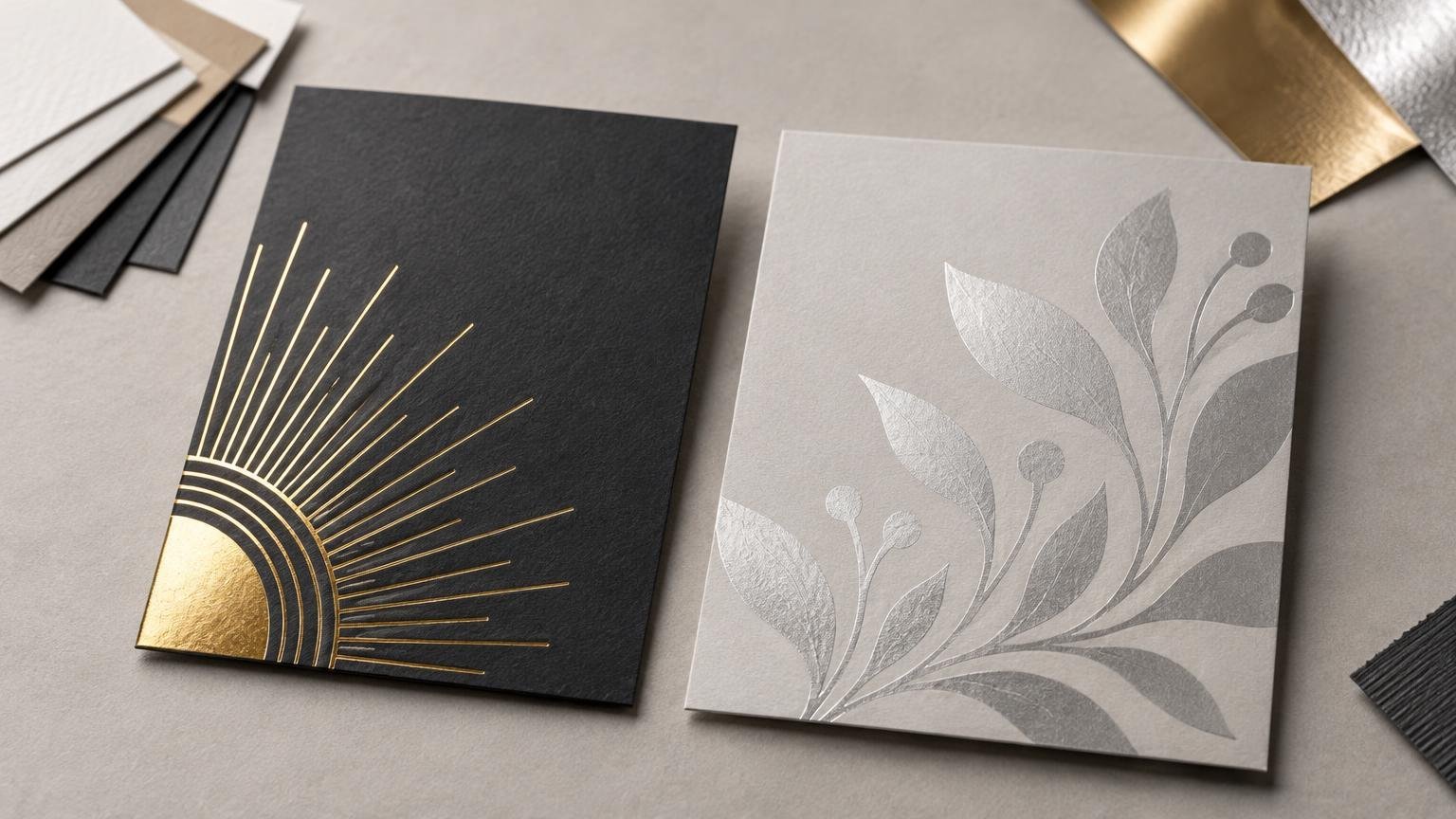
TLDR: In a foil vs metallic ink decision, choose foil when you want selected shapes or typography to read as a distinct reflective material. Choose a defined metallic-print workflow when the artwork needs gradients, halftones, fine tonal changes, or several metallic colors. The important qualification is “defined”: metallic ink is an inconsistent vendor label, so ask whether the printer uses metallic-pigment ink, metallic toner, CMYK over silver, or a metallized substrate.
Foil and metallic ink can both make a printed piece reflect light, but they do not create that effect in the same way. Foil is transferred onto the printed surface as a separate decorative material. Metallic-pigment ink places reflective particles in an ink vehicle, while other products sold as “metallic printing” may use silver underprinting, toner, or reflective stock. Those differences affect artwork preparation, color control, texture, proofing, and which designs reproduce successfully.
This is a research-based comparison, not a hands-on performance test. No controlled PrintReviewer samples were supplied for measuring reflectivity, abrasion, registration, fingerprints, or durability. The recommendations therefore concern process and artwork fit, not a universal claim that one finish looks better or lasts longer.
The basic difference between foil and metallic ink
A transferred foil is a layered decorative construction rather than metallic-colored ink. KURZ describes hot-stamping foil as a multilayer system involving a polyester carrier, release layer, protective and color layers, metallization, and heat-sealing adhesive. During application, the decorative layers transfer to the intended surface while the carrier does not become part of the finished piece. KURZ’s technical description of transfer foil provides the underlying construction detail.
That construction is why foil should be treated as a separate finish layer. It is commonly used for logos, borders, names, ornaments, and other selected elements. “Foil” alone does not tell you whether the finished area will be flat or raised, however. Raised foil is a distinct offering, and embossing is another separate operation. A printer’s process specification matters more than the generic product label.
Metallic-pigment ink is an actual ink category. Hubergroup, for example, describes sheet-fed offset metallic inks using an ink vehicle and metallic pigment, with silver, gold, and copper shades available in its range. Hubergroup’s metallic ink information supports that general definition. A pigment ink is still only one possible meaning of “metallic ink,” so the term should not be accepted as a complete production specification.
Foil vs metallic ink at a glance
| Decision factor | Transferred foil | Metallic-print workflow |
|---|---|---|
| Physical construction | A decorative layer transferred to selected areas | May be pigment ink, metallic toner, CMYK over silver, or printing on reflective stock |
| Typical artwork role | Distinct accents such as names, logos, rules, and ornaments | Can suit broader tonal artwork when the specified process supports it |
| Gradients and halftones | Do not assume support; confirm with the printer | May be supported, especially in CMYK-over-silver workflows |
| Surface feel | Can be flat or raised depending on the process | Often print-like, but the exact feel depends on ink, toner, coating, and stock |
| Color possibilities | Usually selected from the printer’s available foil colors | Depends on the ink set, silver base, overprinted colors, and substrate |
| File preparation | Often requires a separate one-color mask or finish file | May require ordinary color artwork, spot separations, or a silver-underprint layer |
| Proofing priority | Placement, registration, coverage, edges, and actual foil appearance | Metallic strength, color shift, tonal detail, coverage, and substrate interaction |
| Cost and turnaround | Depends on method, tooling, quantity, coverage, and supplier | Depends on press workflow, separations, substrate, coating, quantity, and supplier |
The table is deliberately process-focused. It does not assign universal winners for shine, durability, price, or speed because those outcomes vary with the equipment, material, artwork, stock, coating, quantity, and finishing sequence.
Why “metallic ink” needs a follow-up question
Before comparing quotes, ask the printer to identify the production method in writing. Useful answers include metallic-pigment offset ink, metallic screen ink, metallic toner, CMYK printed over a silver base, or printing on metallized stock. “Premium metallic effect” is not enough information to predict the result.
A silver-under-CMYK workflow illustrates why the distinction matters. UPrinting describes its metallic business-card process as CMYK printing over silver ink. The company says this supports reflective multicolor effects as well as halftones, shadows, fine details, and gradients, distinguishing the workflow from traditional foil stamping. Those are specifications for that product, not proof that every metallic ink service has the same capabilities.
The supplied research also found that UPrinting’s metallic business-card configuration was marked temporarily unavailable when checked. Availability is time-sensitive, so confirm that the product is orderable before designing around its file requirements.
Match the process to the artwork
Choose foil for controlled, deliberate accents
Foil is a logical starting point when the metallic area is a discrete vector element: a logo, name, border, monogram, icon, or short line of display type. The visual separation between ordinary printing and the transferred material can make the accent feel intentional rather than merely metallic-colored.
Keep the design within the selected printer’s minimum line, gap, type-size, and coverage rules. Large solid areas are not automatically safe simply because they are technically possible. They can expose uneven transfer or surface variation, and some suppliers restrict coverage for their own workflow.
MOO’s U.S. special-finish page is a useful vendor-specific example. It lists gold and silver foil on 18 pt Super stock with Soft Touch and requires a separate black-and-white special-finish file. Its supplied guidance says each side must remain below 50% foil or spot-gloss coverage and advises against large solid blocks. Those limits should not be treated as universal foil rules; they apply to MOO’s documented product workflow.
Consider metallic printing for tonal or multicolor effects
A specified metallic-print process may be the better candidate when metallic appearance must pass through gradients, shadows, halftones, fine illustrations, or several colors. CMYK over silver can use the reflective base as part of the color design, while a metallic-pigment ink may be used as a dedicated silver, gold, or copper-colored separation.
This does not mean every photograph will become convincingly metallic or that every gradient will print cleanly. The printer must explain how white, silver, CMYK, substrate color, and coatings interact. Ask for artwork examples made with the exact product rather than examples from an unrelated press or finish.
Do not use foil as a substitute for a photograph
Conventional foil masks are generally built as solid, selected artwork rather than ordinary continuous-tone photographs. If the concept requires detailed tonal modeling, ask about cold foil, digital foil, silver underprinting, or another process that explicitly supports screened or variable imagery. Do not infer those capabilities from the word “foil.”
Hot, cold, digital, and raised foil are not interchangeable
- Hot foil uses heat, pressure, and suitable tooling or equipment to transfer the decorative layer. The exact stock and coating compatibility must be confirmed.
- Cold foil uses an adhesive-based transfer workflow and is often integrated with printing and overprinting. Its production constraints differ from hot stamping.
- Digital foil is a broad commercial label for toner- or adhesive-responsive processes that avoid conventional stamping dies. Capabilities vary by machine and supplier.
- Raised foil adds tactile relief. A plain “foil” listing should not be assumed to include that height.
- Metallic toner deposits a toner-based metallic effect rather than a traditional transferred stamping foil.
- CMYK over silver uses a reflective base beneath process colors, potentially enabling multicolor metallic imagery.
- Metallized stock begins with a reflective substrate. White ink or opaque layers may be used to control which areas remain metallic.
For a closer comparison of selective finishes and tactile effects, see Spot UV vs foil vs raised foil. The key purchasing lesson is the same: request the named process, not just a finish category.
What the choice changes by product type
Business cards
Foil is well suited to a restrained logo, name, or graphic accent when the artwork can use a separate mask. A metallic-print workflow becomes more interesting when the design calls for reflective gradients or multiple metallic colors. Stock, coating, edge treatment, and finish compatibility can matter as much as the metallic process. Buyers comparing suppliers can also review business-card printers offering specialty finishes, while rechecking each provider’s current options.
Invitations
Transferred foil fits monograms, borders, headings, and ornamental details, but fine scripts and reverse shapes need careful review against the supplier’s minimum specifications. Metallic printing may better accommodate shaded illustrations or broader tonal motifs. A physical proof is particularly valuable when the invitation paper has visible texture or an uncoated surface.
Packaging, postcards, and labels
Here, production sequence and end use become critical. Ask whether metallic elements remain compatible with folding, scoring, lamination, varnish, cutting, variable data, and any later conversion step. For mailed pieces, confirm addressing and postal requirements separately rather than assuming a decorative sample represents the final mailing configuration.
Labels and stickers also introduce adhesive, liner, application, moisture, abrasion, and surface-shape questions. When ordering custom stickers, identify whether the requested metallic appearance comes from foil, ink, toner, or reflective film, then ask how printing and protective finishing affect it. A flat sample on a sheet may not predict appearance after application to a curved package.
Proofing matters more than a screen preview
A monitor cannot reproduce angle-dependent reflection. It can show artwork placement and approximate color, but not how strongly a metallic area changes as the piece moves under different lighting. A digital PDF proof therefore answers file and content questions more reliably than physical appearance questions.
For a consequential job, request a production sample, sample pack, or physical proof made with the proposed process, stock, and coating. Inspect it under diffuse room light, direct light, and the lighting expected at the point of use. Check fine edges, small gaps, reverse type, alignment to nearby printing, large-area consistency, fingerprints, and any cracking around folds or scores.
If a custom physical proof is unavailable, obtain a representative sample and treat it as process evidence, not a guarantee. Different artwork coverage, production batches, substrates, and finishing sequences can still change the result. PrintReviewer’s review methodology similarly recognizes that manufacturing results may vary by product, finish, batch, and shipment.
Pre-order checklist
- Ask for the exact process name and press or finishing description.
- Confirm the stock, thickness, surface texture, coating, and printed sides.
- Request available foil, pigment, toner, silver-base, or substrate colors.
- Obtain minimum line, gap, type-size, reverse-type, and registration specifications.
- Confirm whether gradients, halftones, transparencies, and photographs are supported.
- Ask whether a separate vector mask, spot-color separation, or silver-underprint layer is required.
- Check maximum coverage and whether large solid areas are recommended.
- Confirm compatibility with lamination, varnish, folding, scoring, cutting, mailing, and application.
- Request a physical sample or production proof whenever appearance is critical.
- Compare total delivered cost, including setup, tooling, proofs, coatings, shipping, and rush charges.
- Review the printer’s defect, reprint, and remedy policy before approving production.
Common questions
Is metallic ink real foil?
No. Metallic-pigment ink contains reflective pigment in an ink vehicle, while foil is a transferred decorative material. A vendor may use “metallic printing” for other processes, so verify the construction.
Does metallic ink look as shiny as foil?
There is no responsible universal answer. Reflectivity depends on the exact ink or foil, coverage, substrate smoothness, coating, print density, viewing angle, and lighting. Compare physical samples made with the proposed configurations.
Is foil naturally raised?
No. Foil may be applied as a relatively flat finish. Raised foil, embossing, and other tactile effects require specific processes. PrintReviewer’s existing finish guide also distinguishes transferred foil from raised foil and printed metallic simulations.
Which option is cheaper or faster?
Neither process is always cheaper or faster. Quantity, tooling, setup, coverage, stock, coatings, proofing, supplier capacity, shipping, and promotions can reverse the comparison. Request matched quotes using the same size, quantity, printed sides, stock, finish coverage, proof level, and delivery destination.
The practical verdict
Treat foil vs metallic ink as a process-selection question, not a contest between two generic looks. Start with transferred foil for distinct reflective accents. Investigate metallic-pigment ink, CMYK over silver, metallic toner, or metallized stock when the design requires tonal detail, gradients, or multicolor reflective imagery.
Before committing, get the printer to name the process, provide its file and coverage limits, and show a physical example on a comparable stock. That short verification step is more useful than relying on “foil,” “metallic,” or “premium” in a product title—and it can prevent an expensive mismatch between the screen design and the finished print.
References
- www.kurz-world.com
- Print Solutions Division | USA
- Metallic Business Cards | UPrinting
- Special Business Card Finishes | Foil | Spot UV
- Review Methodology – The Print Reviewer
- Spot UV vs Foil vs Raised Foil: Which Business Card Finish Is Worth the Upgrade? – The Print Reviewer