
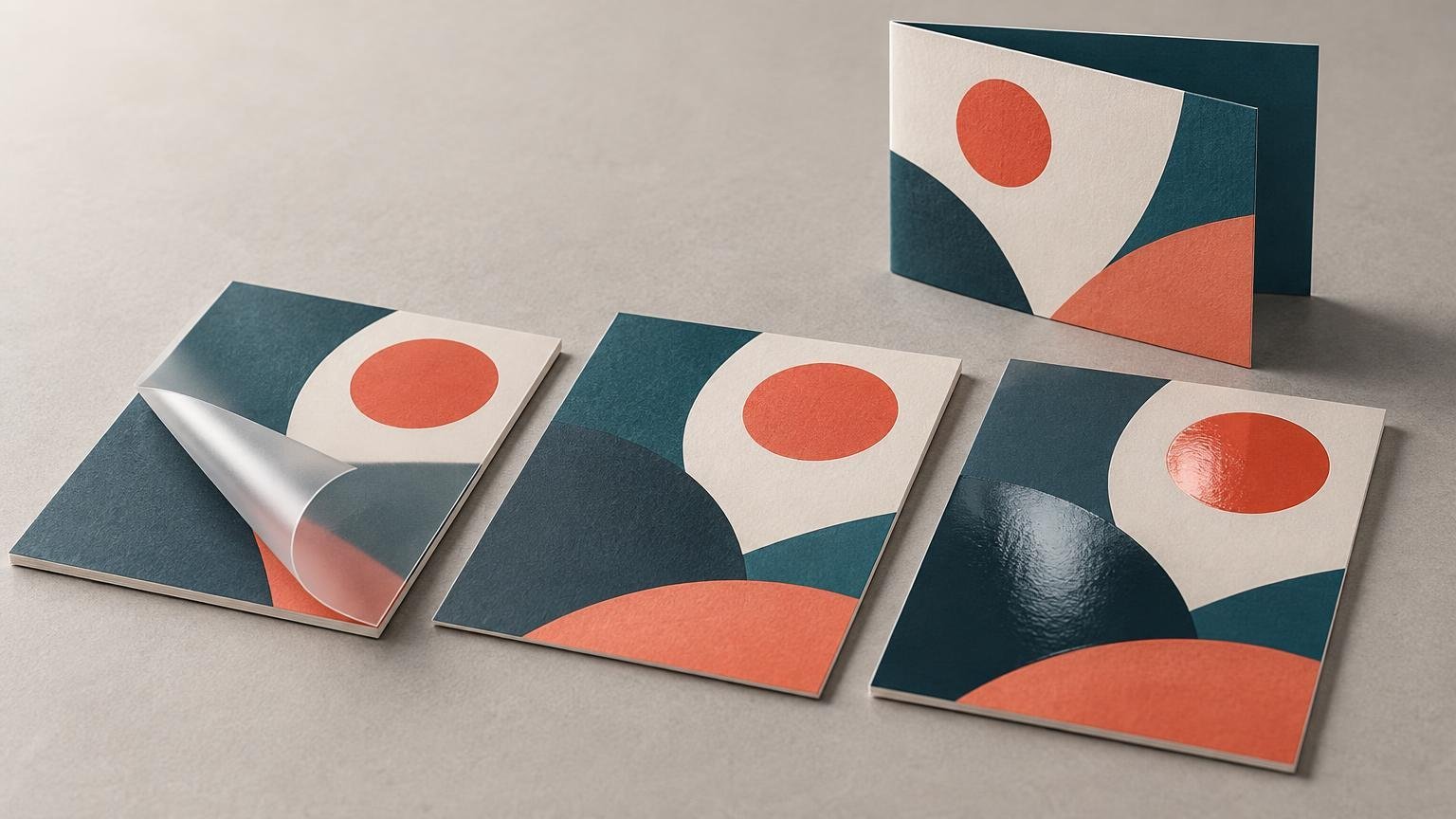
The useful answer to lamination vs coating printing is that these are not two neatly standardized finishes. Lamination generally means bonding a film over a printed surface. “Coating” can mean aqueous coating, UV coating or varnish, each with a different application and curing process. It can also be confused with coated paper, which describes the stock rather than a post-print finish.
There is no universal winner. Choose lamination when a film surface, a pronounced tactile change or a particular film construction serves the job. Choose an overprint coating when you want a press-applied finish, selective gloss or another effect available through the printer’s specific process. Folding, handwriting, glare, handling and price can all change the answer.
This is a research-based technical comparison, not a report of a matched PrintReviewer test order. The conclusions distinguish documented process information from performance that would need to be verified using actual samples.
What lamination and coating mean in printing
In commercial sheet printing, film lamination usually refers to a transparent polymer film bonded to the printed sheet. Some printing segments use “lamination” more broadly, but treating it as a film finish keeps this comparison useful. HP technical material, for example, uses broader language that can include a transparent film or clear coat, showing why buyers should confirm the actual construction rather than rely on the label alone. HP’s technical material on graphic finishing
An overprint coating is applied as a liquid over printed ink. The three common categories relevant here are aqueous coating, UV coating and varnish. PrintRunner and UPrinting distinguish these finishes from coated stock and from one-side or two-side stock descriptions such as C1S and C2S.
- Aqueous or AQ coating: A water-based clear coating commonly offered in gloss or dull appearances. It is applied over the print and dries quickly.
- UV coating: A clear coating cured with ultraviolet light. It may be used across the sheet or selectively for a high-sheen contrast effect.
- Varnish: A clear, ink-like finish that may have gloss, dull or matte appearance and can be applied as a flood or spot treatment.
- Coated stock: Paper manufactured with a coated surface. It is a substrate choice, not automatically evidence that an aqueous, UV or varnish finish was added after printing.
“Flood” means the finish covers an overall area, often the full printed surface. “Spot” means it is applied only to selected elements, such as a logo, photograph or pattern. Spot UV is therefore a design effect as much as a protective finish. It should not be treated as a direct substitute for full-sheet lamination without considering how much of the sheet is actually covered.
Lamination vs coating printing at a glance
| Decision factor | Film lamination | Aqueous coating | UV coating | Varnish |
|---|---|---|---|---|
| Basic construction | Transparent film bonded to print | Water-based liquid overprint coating | Liquid coating cured with UV light | Clear, ink-like coating |
| Typical design role | Changes the overall surface and may add a tactile film effect | Overall gloss or dull finish | High sheen, flood coverage or selective contrast | Gloss, dull or matte appearance; flood or spot use |
| Tactile potential | Can be substantial, especially with soft-touch films | Usually selected more for surface finish than a strong film feel | Can create smooth gloss or a localized raised effect when specifically offered | Generally closer to an ink-like surface treatment |
| Fold concern | Compatibility depends on film, stock, adhesive, grain, scoring and construction | Must be checked for the exact folded piece | Published technical guidance warns UV can crack on folds | Ask the printer about the exact varnish, stock and fold |
| Writing concern | Depends on film and writing instrument | Coated surfaces may resist some pens or inks | Glossy UV areas are generally poor writing zones | Depends on formulation and sheen |
| Selective application | Printer-dependent; often used as an overall finish | Usually offered as an overall coating, though capabilities vary | Commonly available as flood or spot UV | Can be applied as flood or spot |
| What to verify | Film type, thickness, sides, edge treatment and fold compatibility | Sheen, coverage, sides and writable areas | Flood or spot, fold position, cure, sides and writable areas | Sheen, flood or spot coverage and downstream use |
The table describes process families, not guaranteed performance. Two printers can use different films, coating formulations, presses and application settings under the same finish name. The stock, ink system, curing, adhesion and later cutting or folding operations also affect the finished piece.
When film lamination makes sense
Lamination is the clearer starting point when the buyer wants a film-defined surface. Gloss film can increase visual reflectivity, while matte film can reduce glare and create a more subdued look. Soft-touch films aim for a distinct tactile effect. Those appearance choices are examined more closely in the matte vs gloss lamination comparison and the soft-touch vs matte lamination guide.
A film may also be specified when added surface protection is part of the goal, but that should not become a blanket claim that every laminate is more durable, waterproof or scratch-resistant than every coating. Performance depends on the film, adhesive, edge exposure, substrate, application quality and conditions of use. A sample subjected to realistic handling is more informative than the finish name.
Lamination can introduce construction questions that are easy to overlook. A fold passes through the complete combination of stock, ink, adhesive and film. Thick or stiff constructions may require appropriate scoring, grain direction and production planning. Book covers, menus, cards and packaging can also have different edge and delamination risks. Ask the printer to approve the exact stock-and-film combination for the intended operation.
When aqueous coating is the practical choice
Aqueous coating is a water-based clear finish applied like an overprint coating. PrintRunner describes it as available in gloss or dull forms, while UPrinting characterizes it as water-based and fast-drying. It is often relevant when a buyer wants an overall press-applied finish without specifying a separate film layer.
That does not establish how a particular AQ coating will resist rubbing, moisture or scratches on a particular job. Those outcomes depend on the coating formulation, coverage, ink, stock and production conditions. If handling performance matters, request a finished production sample or a proof using the proposed construction rather than assuming all aqueous-coated pieces behave alike.
AQ coating is also not automatically suitable for a piece that recipients must write on. Technical guidance for coated surfaces warns that handwriting and inkjet use can be difficult. A postcard, appointment card or form may therefore need an intentionally uncoated writing area or an uncoated reverse side. Test the actual pen or downstream printer that will be used.
Where UV coating differs
UV coating is cured using ultraviolet light and is frequently chosen for strong surface shine or visual contrast. Billerud’s technical guide to varnishes and coatings describes UV as both a high-sheen finish and a spot effect. This makes it useful when the design calls for a glossy logo or image against a contrasting background.
Flood UV and spot UV solve different problems. Flood UV covers a broad area, while spot UV highlights selected artwork. Raised spot UV adds tactile relief and should be treated as another distinct specification rather than as a synonym for ordinary spot UV. The spot UV vs raised UV comparison explains that distinction in more detail.
Folding is the main caution. Billerud notes that UV finishes can be vulnerable to cracking when folded, and UPrinting gives a similar warning for UV-coated folded or scored boxes. This does not mean every UV-coated fold will fail. It means the coating, stock, ink coverage, grain direction, score and fold position need to be evaluated together.
For a brochure or folding carton, show the printer exactly where the folds cross coated areas. Ask whether the recommended construction has been produced successfully on the proposed stock. A flat UV-coated postcard and a heavily folded box are not equivalent tests.
Why varnish should remain a separate category
Varnish is often lost inside the generic word “coating,” but it deserves its own line on the quote. Billerud describes it as a clear, ink-like coating available in gloss, dull or matte appearances and suitable for flood or spot application.
That makes varnish useful for overall sheen control or localized visual contrast, depending on the printer’s capabilities. It should not be assumed to provide the same feel, film construction or handling performance as lamination. Nor should it be assumed to match UV merely because both can be used selectively. The buyer should compare the exact specified finishes, not the broad category names.
Choose by the finished product, not by “premium” language
Business cards and promotional cards
Use film lamination when the film’s feel or overall appearance is central to the card. Consider spot UV when selective gloss is the intended design feature. For cards that must accept handwriting, preserve and test a writable zone. Buyers comparing more decorative combinations can review the business-card specialty finish guide.
Brochures and folded leaflets
Start with the folds. Ask whether the finish crosses them, whether the stock will be scored and whether the printer recommends the proposed coating or film construction. UV deserves particular scrutiny because published technical guidance identifies fold cracking as a risk. A lower-gloss coating or different construction may be the better decision if reliable folding matters more than maximum sheen.
Menus and frequently handled flat pieces
Buyers often begin with cleaning and handling expectations, but finish names alone do not establish real-world resistance. Describe the expected exposure, cleaning method, replacement cycle and edge handling. Then request a relevant sample and written confirmation of the proposed material. A film laminate may be appropriate, but the choice should follow the use conditions rather than a generic durability hierarchy.
Folding cartons and packaging
Packaging combines visual finish with scores, folds, glue areas and assembly. Keep coatings and films away from functional areas when the converter requires it, and have the printer confirm compatibility. UPrinting, for example, lists aqueous coating and soft-touch lamination as separate options on at least one box product, illustrating that they are distinct configurations rather than interchangeable labels. That menu is product-specific and should be rechecked before ordering.
Book covers and presentation pieces
Lamination may be attractive when an overall film surface or tactile effect is the objective. UV or varnish may make more sense when selective contrast is the design priority. Consider hinge and score behavior, glare under expected lighting and how dark solid colors will show fingerprints or surface marks. For a broader view of what happens after ink reaches the sheet, see the guide to post-press printing or Printiverse’s print-production resources.
Questions to put on the printer quote
A useful quote names the construction instead of saying only “gloss,” “matte” or “coated.” Before approving the job, confirm the following:
- Is the finish a film laminate, aqueous coating, UV coating or varnish?
- What exact sheen or tactile version is being quoted?
- Is coverage flood or spot, and which artwork elements receive it?
- Is the finish applied to one side or both sides?
- What stock, ink and finish combination will be used?
- Will any fold, score, glue flap, perforation or cut pass through the finished area?
- Does the printer recommend scoring or another construction change?
- Which zones must remain writable, inkjet-printable, glueable or stampable?
- Can the printer provide a physical sample made with the same finish and a comparable stock?
- Does the sample demonstrate only appearance, or also the folding and handling conditions relevant to the job?
- What are the total price, setup charges, proof costs, production time and shipping cost for the same quantity and configuration?
If comparing vendors, normalize size, quantity, stock, printed sides, coverage, finish area, turnaround and shipping. A low base price for an uncoated job is not comparable with a delivered quote that includes two-sided lamination or registered spot UV.
The bottom line
Lamination is generally a bonded film; aqueous, UV and varnish are liquid overprint finishes. Coated paper is the underlying stock and should not be confused with either. Once those definitions are clear, the decision becomes practical rather than promotional.
Choose according to the required surface, visual contrast, tactile effect, folds, writing areas and handling conditions. For a flat piece that needs selective shine, spot UV may be the logical specification. For an overall film feel, lamination is the more direct route. For a broadly applied press finish, aqueous coating or varnish may be sufficient. When failure would be costly, approve a sample using the intended stock and finish—and include the actual fold, pen, cleaning method or handling condition in the test.
Frequently Asked Questions
Is lamination the same as coating in printing?
Not usually. Commercial sheet-print lamination generally bonds a transparent film to the print, while aqueous, UV and varnish coatings are applied as liquids. Terminology can vary, so confirm the actual construction with the printer.
What is the difference between coated paper and an overprint coating?
Coated paper is the underlying stock. An overprint coating, such as aqueous, UV or varnish, is applied over the printed ink as a finishing step.
Can UV coating crack on a folded brochure or box?
Yes, fold cracking is a documented risk for UV finishes. Suitability depends on the coating, stock, ink coverage, grain direction, scoring and fold position, so ask the printer to evaluate the proposed construction.
Can recipients write on a coated card?
Some coated surfaces can be difficult to write on. Preserve an uncoated writing area or reverse side when needed, and test the actual pen or downstream printer before production.
What should I confirm before choosing lamination or coating?
Confirm the exact finish, sheen, flood or spot coverage, one- or two-sided application, stock and ink combination, fold and score locations, writable or glueable zones, and whether a comparable physical sample is available.
References
- hpHP Latex Inks
- Glossary of Printing Terms | PrintRunner
- UPrinting | Glossary
- www.billerud.com
- Candle Boxes – Custom Printed Packaging Boxes | UPrinting