
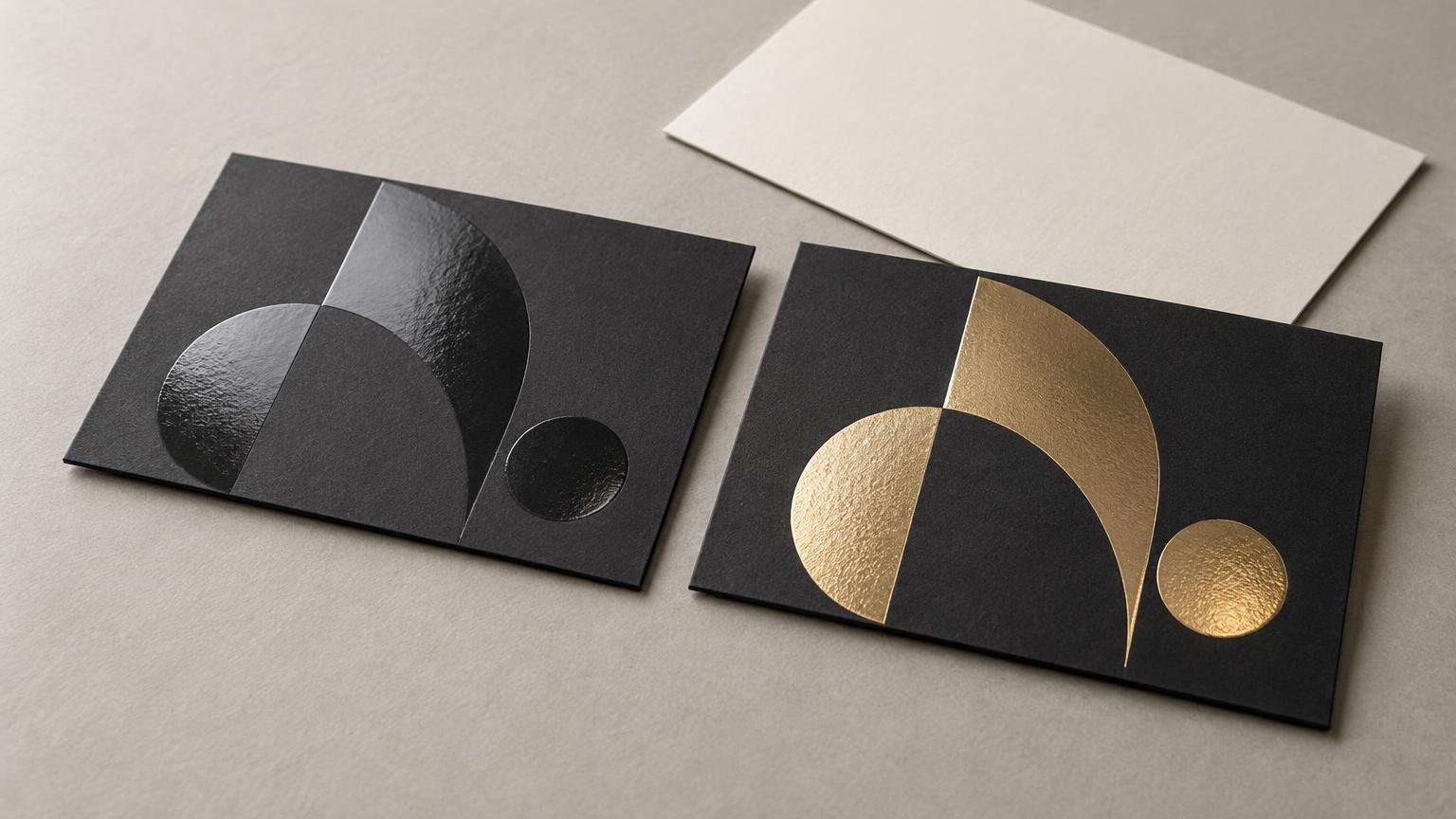
Spot UV and foil solve different design problems. Choose spot UV when you want clear gloss, tonal contrast and restrained detail without adding another color. Choose foil when the design needs an unmistakably metallic or colored reflective element. Neither is automatically more premium, and the more expensive quote is not automatically the better choice.
This is a research-based finish comparison, not a hands-on test of matched samples. The conclusions below come from production documentation and current supplier guidance rather than side-by-side measurements of gloss, registration, durability or delivered color. That distinction matters because stock, lamination, artwork, production method and quality control can change the result.
The physical difference between spot UV and foil
Spot UV, also called spot gloss by some printers, is a transparent UV-curable coating applied only to selected parts of a printed surface. The coating creates a high-gloss area while allowing the color or image underneath to remain visible. The effect comes from a change in surface reflectivity, not from a new metallic color. The Heidelberg technical information for UV gloss coating identifies the material as UV-curable, while MOO describes its Spot Gloss as a transparent coating applied to chosen areas.
Foil is a transferred decorative layer. It can supply metallic color, reflectivity or other optical effects that ordinary transparent gloss does not. The exact production route varies: hot stamping, cold transfer and digital transfer are distinct processes. The KURZ description of transfer finishes details a layered foil construction and distinguishes among those transfer methods.
That distinction produces the practical answer. Spot UV modifies how the printed artwork reflects light. Foil places a separate visual element over or into the surface. If you want a dark logo to appear and disappear as a card tilts, spot UV can do that. If you need the logo to read as gold, silver, copper or another foil color, clear spot UV cannot substitute for it.
| Criterion | Spot UV | Foil | Buyer consequence |
|---|---|---|---|
| What it adds | Selective transparent gloss | A transferred decorative layer | Spot UV preserves the underlying print; foil introduces its own color or optical effect |
| Typical visual character | Tonal, glossy and dependent on lighting | Metallic or colored reflection | Foil usually announces itself faster; spot UV can feel more restrained |
| Texture | Flat products may feel smooth or only subtly different | Flat foil may be pressed into the surface | Do not assume either finish is raised |
| Artwork role | Highlights existing print or creates gloss-only shapes | Creates a distinct foil separation | Both normally require dedicated finish artwork |
| Best fit | Patterns, logos, photos and selective contrast | Names, marks, borders and deliberate accents | The design objective should choose the process |
Flat, raised and stamped are not interchangeable terms
The most common buying mistake is treating “spot UV” as a synonym for raised gloss and “foil” as a synonym for traditional hot stamping. Online printers use overlapping product names, and two products with similar thumbnails may have noticeably different surface profiles.
Regular spot UV can be a relatively flat selective coating. Raised spot UV intentionally builds more relief. MOO describes its Raised Spot Gloss as more elevated and three-dimensional than its regular Spot Gloss. UPrinting describes its raised spot UV and raised foil as approximately 50 microns above the surrounding surface. Those statements apply to the named products; they are not universal thickness specifications for every printer.
Foil also covers several processes. UPrinting says its raised-foil cards use pressure and heat to transfer metallic foil to paper, which identifies that supplier’s process. KURZ separately documents hot, cold and digital transfer routes. Ask what the quoted product actually uses rather than assuming every “foil” option is made with a heated metal die.
If tactile relief is central to the project, compare raised spot UV with raised foil—not ordinary spot UV with an unspecified foil product. The broader guide to business-card printers offering specialty finishes can help narrow the supplier list once you know which finish category you need.
How the two finishes behave in a design
Spot UV depends heavily on the base surface
Transparent gloss needs contrast. A glossy accent usually reads most clearly against a matte, soft-touch or otherwise low-sheen background. On an already glossy surface, the visual difference may be weaker because both the base and the selected area return strong reflections. Artwork color matters too: spot UV over black can produce a restrained tone-on-tone effect, while the same coating over a colorful image preserves that image and changes its sheen.
This makes spot UV useful for patterns, watermarks, large initials and details that should reward a closer look. It is less suitable when the element must remain obvious in flat, diffuse lighting. A clear coating cannot guarantee that a subtle mark will be immediately legible from every angle.
Foil supplies a more explicit accent
Foil is the clearer choice when metallic color is part of the identity rather than merely an interaction with light. MOO describes its Gold Foil as more reflective than its regular Spot Gloss, although that is a supplier description rather than an independent measurement.
That visibility can become a liability when foil coverage is excessive. Large metallic areas can dominate typography and imagery, while multiple foil details can turn hierarchy into glittering noise. Foil is often most effective when the design gives it one clear job: a logo, name, short line, border or compact emblem.
Neither flat finish guarantees strong texture
MOO describes ordinary Spot Gloss as smooth and subtle and says its Gold Foil is less tactile than Raised Spot Gloss. UPrinting distinguishes flat spot UV, flat foil, raised spot UV and raised foil as separate products. The safe conclusion is simple: order a raised product when touch is a primary objective, and verify the actual construction before paying for it.
Artwork preparation can decide whether the upgrade succeeds
Special finishes typically need a separate mask or finish file that tells the printer where to place the coating or foil. MOO requests a main artwork file and a black-and-white special-finish file for its special-finish cards. Its Spot Gloss instructions specify PDF files, vector artwork and finish elements set to 100% black.
Fine text, hairline borders, tiny counters and tightly spaced finish elements increase production risk. The exact thresholds are supplier-specific. UPrinting’s published guidance for relevant products calls for text of at least 12 points, foil strokes or borders thicker than 1.5 points, and separation between certain special-finish elements. Its standard Spot UV instructions also require a 1/16-inch gap where foil and spot UV are used in the same design.
Those figures are useful preflight warnings, not industry-wide laws. A printer using different equipment or a different transfer process may publish different tolerances. Build the file to the chosen supplier’s template, not to a generic blog diagram.
- Use vector shapes for small finish elements whenever the printer requests them.
- Keep critical foil or gloss details away from trim, folds and perforations unless the template explicitly permits them.
- Avoid using the special finish as a substitute for ordinary printed text.
- Check minimum type size, stroke width, spacing and maximum coverage for the exact product.
- Request a proof that shows the finish separation, while recognizing that a screen proof cannot reproduce physical gloss, metallic reflection or relief.
- For high-value jobs, ask whether a physical proof or short production sample is available.
Coverage limits are a design constraint, not fine print
Special finishes are generally intended as accents. MOO’s current Spot Gloss and Gold Foil product pages advise keeping finish coverage below half of each side and avoiding large solid blocks. UPrinting gives an approximately 50% maximum for relevant foil and raised-finish products. These are product-specific limits, and some support documentation gives different figures, so the live template and preflight instructions should control the final file.
Coverage also affects the visual argument. If half the card is shiny, the finish stops directing attention and becomes the background. Before approving a broad area, ask whether an ordinary gloss stock, metallic ink, metallic paper or full-surface lamination would accomplish the job more coherently.
How to compare price without comparing unlike products
A meaningful spot UV versus foil price check must hold the rest of the order steady. Quantity alone is not enough. Match card size, stock thickness, base coating or lamination, printed sides, finish sides, corner style, production speed, shipping destination and promotional status.
Supplier storefronts make this harder than it sounds. The researched MOO pages displayed the same starting figures for its Spot Gloss and Gold Foil cards, but those figures exclude shipping, tax, promotions and configuration changes. UPrinting’s displayed defaults used different stocks, quantities or production settings across flat and raised products. MOO described delivery timing, while UPrinting labeled a printing-time period. Those numbers cannot support a clean claim that one finish is cheaper or faster.
Build two matched carts with the same supplier where possible. Record the subtotal, setup or proof charges, shipping, tax, estimated delivery date and finish coverage assumptions. If different suppliers are involved, include the base stock and lamination in the comparison. A cheap foil quote on a lighter uncoated card is not equivalent to raised foil over silk lamination.
If the project includes a broader set of printed pieces, Printiverse covers general custom printing and related production topics. Keep the finish decision tied to the full order: a business card can look excellent while creating unnecessary inconsistency with folders, postcards or packaging that cannot reproduce the same effect.
Which finish should you choose?
Choose spot UV for controlled gloss contrast, tone-on-tone patterns, image highlights and designs where the underlying print should remain visible. It is the more natural option when the desired effect is “notice the surface when it catches the light,” not “this element must look metallic.”
Choose foil when metallic or colored reflection is a required part of the design. It suits compact logos, names, borders and decorative marks that need to remain visually distinct from the printed background. Verify the available foil color and transfer process; “gold” from two suppliers may not have the same hue, reflectivity or surface character.
Choose a raised version only when tactile relief justifies the added constraints and cost. Raised effects need enough physical space for the detail to reproduce cleanly, and supplier guidance commonly discourages tiny type, thin strokes and crowded elements. A flat finish is often the better value when the design goal is visual rather than tactile.
For buyers who want several premium variables at once, the guide to premium business cards explains how stock, foil and other upgrades interact. Resist stacking finishes merely because the configurator permits it. One well-controlled accent usually communicates more than three competing upgrades.
The final verdict
Spot UV is the better finish for selective clear shine and understated contrast. Foil is better for an explicit metallic or colored reflective feature. Raised spot UV and raised foil belong in a separate tactile comparison; neither should be confused with its flatter counterpart.
The deciding question is not which finish sounds more luxurious. It is whether the artwork needs transparent gloss, a transferred decorative layer or physical relief. Define that requirement first, then compare matched quotes and build the finish file to the selected printer’s current tolerances. That approach will do more for the finished piece than buying the most expensive embellishment on the menu.
Frequently Asked Questions
Does spot UV look metallic?
No. Spot UV is a transparent, selectively applied gloss that changes how the underlying print reflects light. Foil adds a transferred metallic or colored layer.
Are spot UV and foil always raised?
No. Printers sell flat and raised versions as distinct products. Order a raised finish only when tactile relief is part of the design objective, and verify the product construction before buying.
Do special finishes require separate artwork?
Typically, yes. For example, MOO requests main artwork plus a black-and-white special-finish file, with vector finish elements set to 100% black for Spot Gloss. Requirements vary, so use the chosen printer’s current template.
Can spot UV and foil appear in the same design?
Some products allow both, but placement rules can apply. UPrinting’s standard guidance says the finishes cannot overlap and requires a 1/16-inch gap between them. Treat that as supplier-specific rather than a universal rule.
Which finish is cheaper?
There is no reliable universal winner. Compare matched carts with the same quantity, stock, printed sides, finish sides, production speed, shipping and promotions; otherwise, the quotes describe different products.
References
- # Technical information
- KURZ Sustainability Report 2024 // 3. Company Profile /// 3.5 KURZ Surface Decors
- Spot UV Business Card Printing – Custom Spot Gloss Business Cards
- Spot UV Business Cards – Gloss Highlights | UPrinting
- Design and Print Raised UV Business Cards With Soft Touch Details
- All Print Products & Services | UPrinting
- Foil Business Cards – Shine with Gold, Silver, Copper | UPrinting
- Spot UV Business Cards – Glossy Accents on Matte or Gloss Cardstock | UPrinting
- Custom Gold Foil Stamped Business Cards – Design & Print With MOO
- Raised Foil Business Cards – Brilliant Metallic Designs | UPrinting