
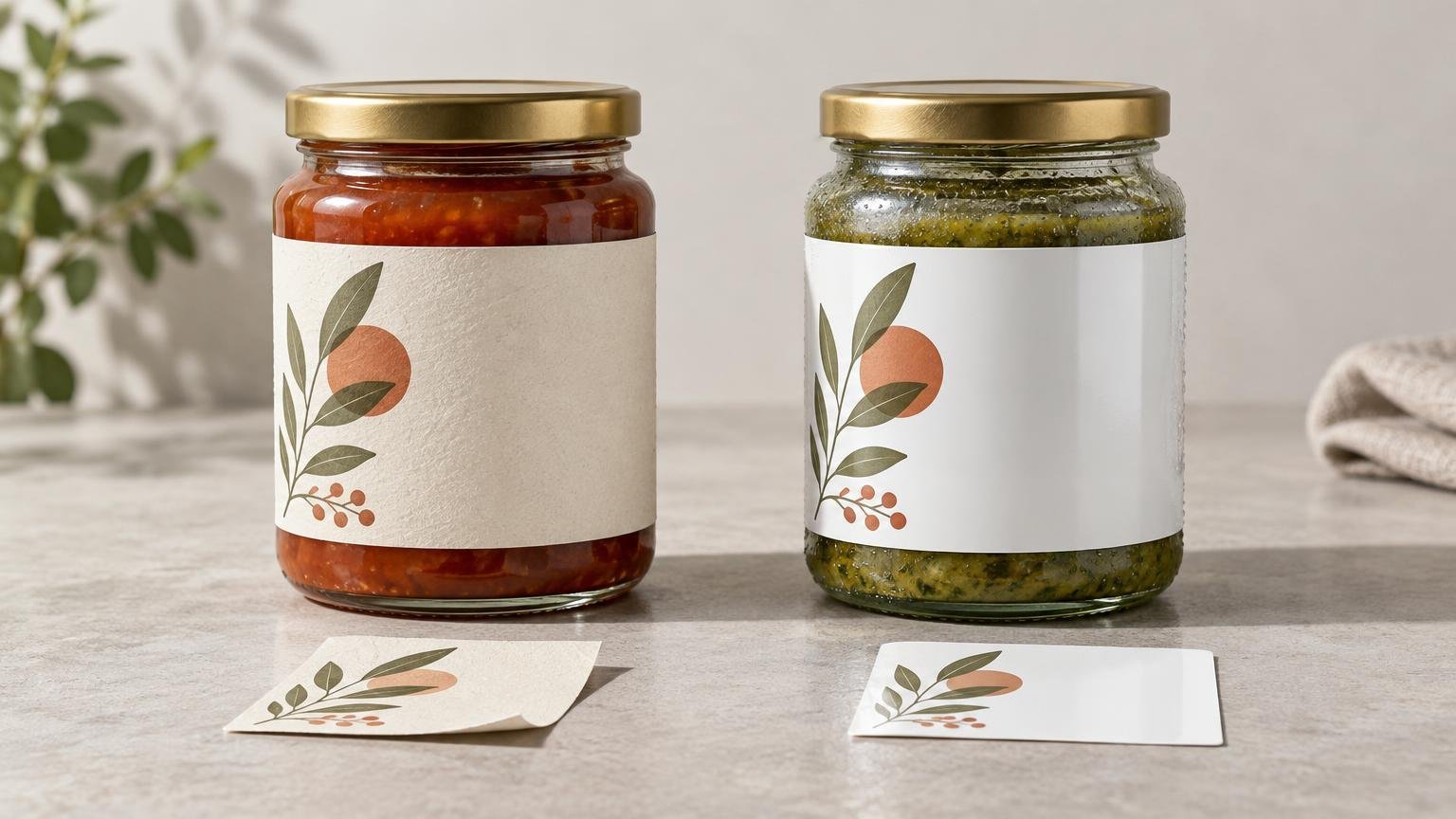
For most small brands, the choice is straightforward: order paper labels for dry, clean packaging when cost or tactile character matters most. Start with BOPP for products exposed to condensation, refrigeration, splashes or frequent handling. That is only a starting rule, however. A label is a construction consisting of facestock, ink, finish and adhesive—not merely “paper” or “plastic.”
This is a research-based material comparison rather than a hands-on test of one printer’s labels. The supplied documentation establishes material options and intended uses, but it does not prove how every construction will perform on your particular bottle, pouch or jar.
The practical differences at a glance
| Decision factor | Paper label | BOPP label |
|---|---|---|
| Dry indoor packaging | Usually a sensible, economical choice | Often more durability than the job requires |
| Condensation or splashing | Needs an appropriate wet-strength or protected construction | Generally the safer starting point |
| Oil or grease exposure | Requires a specifically rated stock and finish | Still requires a suitable ink, coating and adhesive |
| Visual character | Broad choice of natural and embossed textures | Smooth white, clear, gloss, matte and metallic effects |
| Refrigeration | Possible with the right facestock and adhesive | Commonly specified, but adhesive and application temperature remain critical |
| Recyclability | Not automatically recyclable as part of a package | Not automatically recyclable as part of a package |
| Typical upfront cost | Often lower for a basic construction | Commonly higher, depending on the specification |
Moisture is where BOPP earns its premium
BOPP means biaxially oriented polypropylene. It is a plastic film facestock sold in constructions including white, clear, metallized, matte and gloss. BOPP films are commonly specified for water resistance and resistance to tearing, which makes them a logical fit for chilled drinks, bathroom products and packages likely to be wiped down.
Standard paper can absorb moisture, wrinkle or lose its visual finish. That does not mean every paper label fails when wet. Wet-strength papers, protective varnishes and laminates can substantially change performance, and specialty beverage papers are designed for wet or ice-bucket exposure. Those engineered products should not be confused with an unspecified economy paper label.
For a dry candle jar, shipping carton or pantry product, paying extra for film may accomplish little. For a refrigerated sauce bottle that develops condensation, ordinary paper is a risk unless the supplier confirms the complete construction is intended for that exposure.
Oil resistance is not guaranteed by the word BOPP
Oil, grease and chemical resistance depend on the whole label system. BOPP overlaminates are available with oil- and chemical-resistant properties, but that does not establish that every BOPP label uses the same protective layer. Paper suppliers likewise offer stocks selected for oil and grease resistance. Ink compatibility, curing and any topcoat or laminate must also be considered.
Brands selling beard oil, salad dressing, cosmetics or automotive products should give the printer a realistic exposure description. Ask whether the printed surface, not just the facestock, is rated for incidental oil contact. A moisture-resistant film with unprotected ink can still become an unattractive label.
Refrigeration is partly an adhesive problem
Two temperatures matter: the temperature when the label is applied and the temperature during later use. A label applied to a clean container at room temperature and then refrigerated faces a different challenge from one applied directly to a cold, damp bottle. Minimum application temperature and service temperature are separate specifications. Product-specific BOPP constructions may support cold application and much colder service conditions, but those figures cannot be generalized to all BOPP labels.
Before ordering refrigerated labels, tell the supplier the container material, application temperature, expected service temperature and whether condensation will already be present. Apply samples using the real workflow, then refrigerate them long enough to check edge lifting, bubbling and label movement.
Paper offers texture; BOPP offers smooth visual effects
Paper has the stronger case when the label itself should feel crafted. Available surfaces can include vellum, laid, linen, felt and hammered textures, with compatible constructions supporting embellishments such as foil, embossing and debossing. This can suit wine, candles, preserves and premium dry goods where touch contributes to the presentation.
BOPP is better suited to a smooth graphic treatment. White film gives artwork an opaque base, clear film can create a no-label appearance, and metallized film supports reflective effects. Neither material is inherently more vibrant: the print process, receptive topcoat, ink or toner, artwork coverage and finish all affect the result.
For a wider three-material durability comparison, see vinyl vs BOPP vs paper stickers. If the decision has moved from material selection to supplier selection, the custom label printing guide for small businesses covers additional ordering factors.
Application failures often come from the wrong adhesive
Facestock receives most of the attention, but the adhesive determines whether the label stays attached. Container surface energy, curvature, contamination, label size, adhesive tack, dwell time and application temperature can all change the result. A stiff paper label may flag at the edges on a tightly curved container, while a film construction intended for dispensing can be more conformable or easier to apply consistently.
Request production samples with the proposed adhesive and test them on filled containers, not a convenient sheet of glass. Clean and apply them exactly as staff will during production. Check immediately, after 24 hours and after the intended cold, wet or oily exposure. The broader custom sticker printer comparison checklist can help normalize specifications and delivered cost between vendors.
Recyclability requires a package-level answer
Paper is not automatically the environmentally preferable label, and BOPP is not automatically incompatible with recycling. The outcome can depend on the base container, label coverage, adhesive, coatings, inks, multilayer components, sorting behavior and the local recycling system. The Canadian Council of Ministers of the Environment guidance, Association of Plastic Recyclers design guidance and British Plastics Federation recyclability guidance all treat labels as one component of a complete package rather than an isolated material claim.
A polypropylene label on a polypropylene container can be useful because both belong to the same polymer family, but that fact alone does not make the finished package recyclable. Conversely, paper fibers and adhesive separation can complicate some plastic-packaging recycling streams. Ask for evidence tied to the exact label construction, container and target recycling system instead of accepting a broad “recyclable label” claim.
Compare price using the finished specification
Basic paper is often the lower-cost starting point, while white BOPP commonly carries a higher upfront price. Supplier-published estimates support that general direction, but they are not an independent market index. Quantity, dimensions, adhesive, finish, tooling, printing method, freight and the chosen paper grade can shrink or enlarge the difference.
Request like-for-like quotes with the same size, shape, quantity, colors, roll direction, core size and delivery basis. Include any varnish, laminate or wet-strength upgrade needed to make paper suitable for the job. A cheap paper quote is not comparable to a protected BOPP construction if the paper label needs additional finishing to survive.
To inspect custom label, sticker-material and artwork-preparation options before requesting a specification, see details. Do not place the final production order until the supplier identifies the facestock, adhesive and protective finish rather than quoting only “paper” or “BOPP.”
What small brands should order
Choose standard paper for dry, room-temperature products when the lowest practical cost or a natural texture is the priority. Choose a wet-strength or protected specialty paper when tactile branding matters enough to justify testing a more engineered construction.
Choose BOPP as the safer starting point for refrigerated foods, chilled beverages, bathroom products and packaging exposed to splashes or repeated handling. For oils and chemicals, specify the exposure and verify the printed surface, adhesive and finish—not merely the film name.
The final decision should follow a sample test on the real package. Material labels are useful categories, but the complete construction determines whether the finished label looks good, applies cleanly and stays attached.
References
- Datasheet
- Direct Thermal BOPP Product Overview
- Avery Dennison: Paper Materials Technical Guide
- New Wine and Spirit Facestocks | Avery Dennison | LPM
- 2026 Wine, Spirit and Premium Labeling Portfolio
- North America
- Wine and Spirits Labeling Guidelines
- Cold Temperature – Product Overview SSA
- products.averydennison.com
- Fasson Wine & Spirits Label Facestock Guidelines
- Rigid Polypropylene Film Labels | Avery Dennison | LPM
- Adhesives Glossary | Avery Dennison | LPM
- Guidance on the Use of Labels and Terms for Plastic Products and Packaging
- ASSOCIATION OF PLASTIC
- Recyclability By Design
- How Much Do Custom Labels Cost? 5 Pricing Factors Explained | DJB Label
- Custom Label Pricing 2026