
If you’ve ever watched a toddler “read” a book (chew it, throw it, lick it, repeat), you already understand the point of board book binding. Board books are built for tiny hands and maximum abuse: thick paperboard pages, usually rounded corners, and finishes that wipe clean.
This guide explains how board book binding works, why the page count rules are different, and what to watch for when you’re speccing a board book with a printer.
What is a board book?
A board book is a book where each page is made from thick paperboard instead of thin text stock. That page stiffness does two big things:
- Durability: pages resist tearing, creasing, and general chaos.
- Usability: small kids can turn pages without needing adult-level fine motor skills.
Most board books also use rounded corners to reduce sharp edges and help the book survive drops and scrapes.
Why board book binding is not really “binding”
In most book formats, pages are printed on large sheets, folded into signatures, then stitched or glued into a spine. Board books don’t work like that.
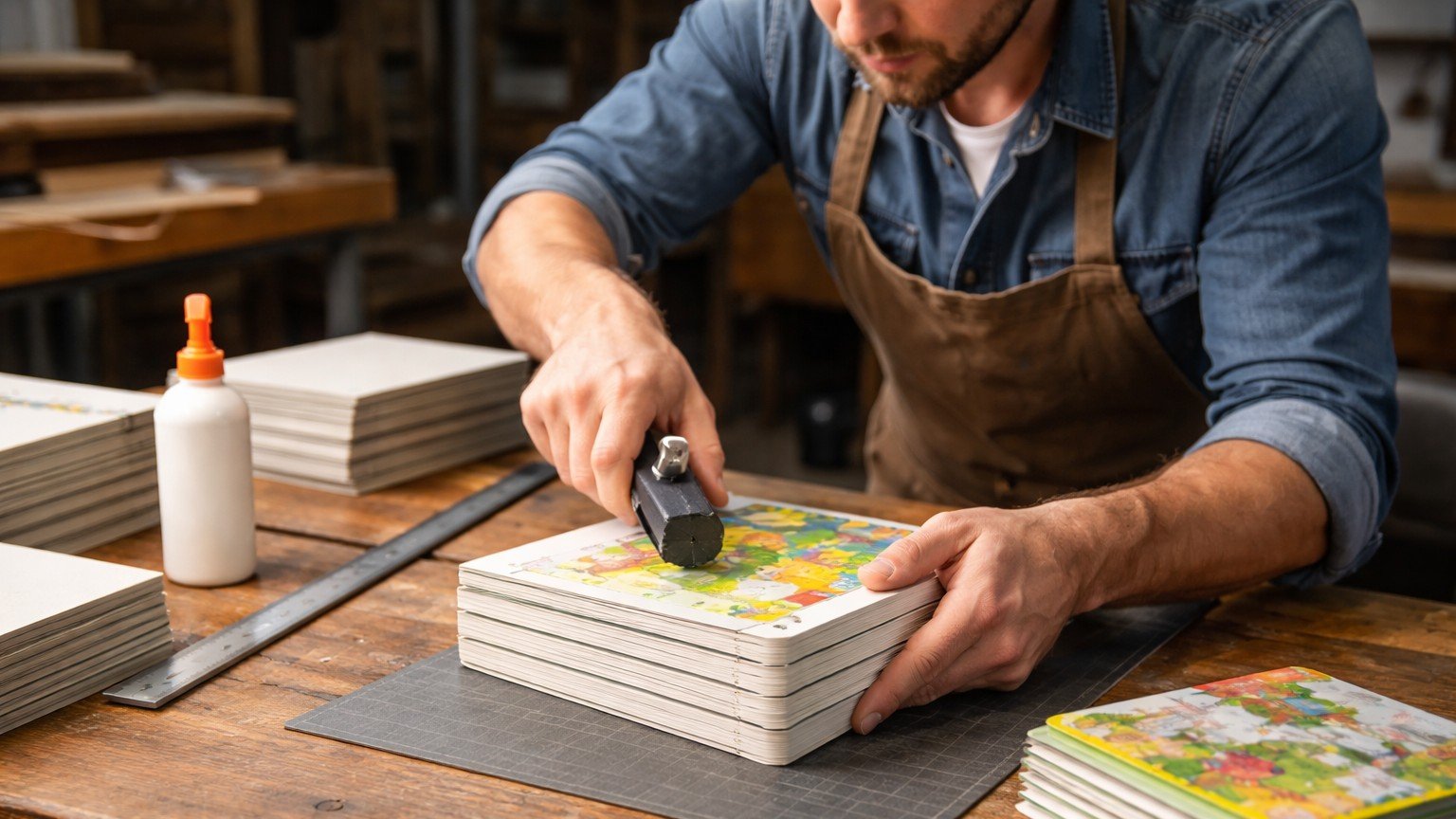
With board book binding, pages are typically made as 2-page spreads (a left page and right page together). Those spreads are printed, cut, and then mounted to board. After that, the spreads are assembled into a book block one spread at a time, and the cover is wrapped around the finished block.
So instead of “fold, gather, bind,” it’s closer to “print, mount, stack, wrap.”
Board book binding step-by-step
Here’s the production flow in plain English.
1) Print the interior as 2-page spreads
Your interior is output as spreads, not loose single pages. This matters for layout, because your artwork needs to account for the way spreads meet at the spine.
2) Mount the printed sheets to paperboard
Each spread gets glued onto board to create that thick, rigid “page.” Depending on the manufacturer, this can involve one board layer or multiple layers for extra thickness and stability.
3) Assemble the book block spread-by-spread
The mounted spreads are glued together one at a time to form the full book. This assembly approach is why board books behave differently than signature-based bindings.
4) Wrap the cover around the block
The cover is usually a printed sheet that gets wrapped around the outside and glued down. This is where the book starts looking like an actual retail product instead of a stack of boards.
5) Finish and trim (including rounded corners)
After assembly, the book is trimmed to final size. Rounded corners are commonly applied here.
6) Lamination or coating for durability
Board books usually get a protective finish on all pages, not just the cover. Gloss and matte are the common choices, and the goal is simple: wipeable, scuff-resistant, and less likely to peel at edges.
Page count rules: why board books count in 2s, not 4s
Most “normal” book interiors follow the multiple-of-4 rule because of how folded signatures work. Board books are a major exception.
Because board books are built from 2-page spreads that are mounted and assembled, your interior page count typically only needs to be in increments of 2. That means you can often hit your exact content length without padding the file with extra blanks just to satisfy signature math.
Quick terminology note:
- A spread = 2 pages (left + right)
- Board books are often planned in spreads first, then converted to total pages.
Materials that matter (more than people think)
Board thickness
Board books are commonly produced by mounting printed sheets onto board in thicknesses like 40pt or 60pt (thicker exists, but it gets bulky fast). Thicker pages feel more premium and take more punishment, but they also increase weight, shipping cost, and the overall “brick factor” of the book.
Finishes: gloss vs matte
- Gloss tends to be more wipeable and shows fewer fingerprints.
- Matte looks softer and more modern, but can show scuffs sooner depending on the lamination and ink coverage.
Adhesives and construction
A board book is basically a durability test for glue. Good construction helps prevent:
- page edges lifting
- delamination at corners
- warping over time (a common issue with board books)
You won’t always get to choose the adhesive, but you can absolutely ask your printer how they prevent warping and edge peel.
Design considerations for board book binding
Board books are forgiving in the hands, but less forgiving in file setup. A few things to plan for:
Rounded corners are not just cosmetic
If you know you’re rounding corners, keep critical text and faces a safe distance from the trim. Corner rounding will remove content that creeps too close.
Account for opening behavior
Board books often include scoring near the spine area so the book opens properly and lays flatter. In practice, that means you should avoid putting tiny details right up against the binding edge, especially if you’re using full-bleed art across a spread.
Keep expectations realistic on perfect alignment
With thick pages and wrapped materials, tiny shifts can happen. Design for it:
- avoid hairline borders near trim
- don’t rely on 1 mm “it must line up perfectly” details across the gutter
Common issues (and how to avoid them)
Warping
Warping can come from moisture, uneven lamination pull, board variation, or storage conditions. Higher-end construction methods and smart materials choices reduce this risk, but it’s still something to ask about up front.
Edge peel and corner wear
Corners are impact zones. Rounded corners and durable lamination help, but heavily handled books will still show wear eventually. If your book is meant to live in diaper bags, assume it will get wrecked and spec accordingly.
Scuffing on matte
Matte can look great, but matte plus heavy ink coverage can show marks. If your art is mostly dark solids, ask about more durable matte options.
When to choose board book binding (and when not to)
Board book binding is a great fit when:
- your audience is babies and toddlers
- you need wipeable, thick, safe pages
- the book is short and designed around spreads (common in children’s formats)
It’s usually not a great fit when:
- you need high page counts (it gets thick and expensive quickly)
- you want cost-effective one-off printing (board books are typically not friendly to print-on-demand economics)
- you need ultra-fine detail near trim and gutter (the format is sturdy, not “precision art book” perfect)
Quick spec checklist
If you’re requesting quotes, have these answers ready:
- Trim size
- Total interior pages (and spreads)
- Board thickness preference (if offered)
- Finish preference (gloss or matte)
- Rounded corners (yes/no, and radius if specified)
- Any special features (die-cuts, touch-and-feel elements, pop-ups)
FAQs
Are board books “handmade”?
Many board books are assembled spread-by-spread, and parts of the process can be manual or semi-automated depending on the shop. What matters is the construction method: mounted spreads assembled into a block, then wrapped.
Do board books need a spine width like hardcovers?
They often use a wrapped cover that includes a spine area, but it’s not the same concept as a thick perfect-bound spine. Your printer will typically provide a cover template based on your final thickness.
Why does my printer keep talking about spreads?
Because spreads are the unit of construction. In board book binding, thinking in spreads helps you avoid page count mistakes and layout problems at the gutter.