
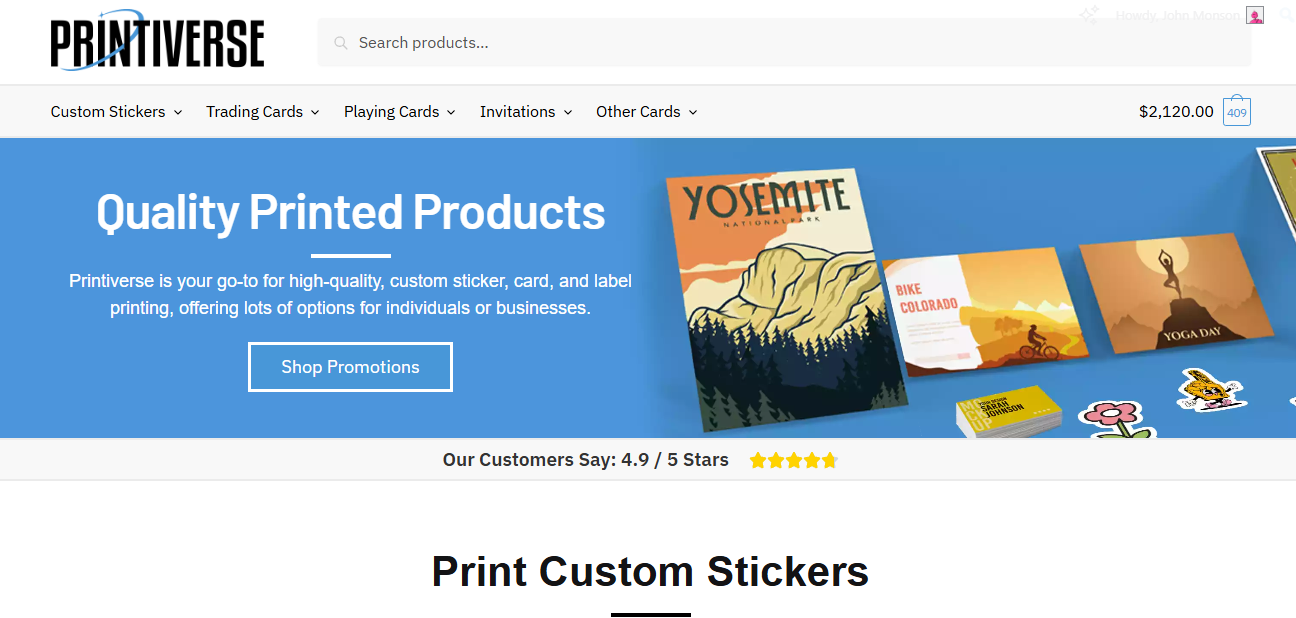
Printiverse is a newer, online focused printer that grew up in the world of custom stickers, trading cards, game cards, and premium card products. The site now offers business cards alongside those core products, with a card design studio, no minimum quantities, free proofs, and a big emphasis on service and speed. In our scoring framework, Printiverse sits in the top cluster of multi product printers for quality, price, customer service, and turnaround.
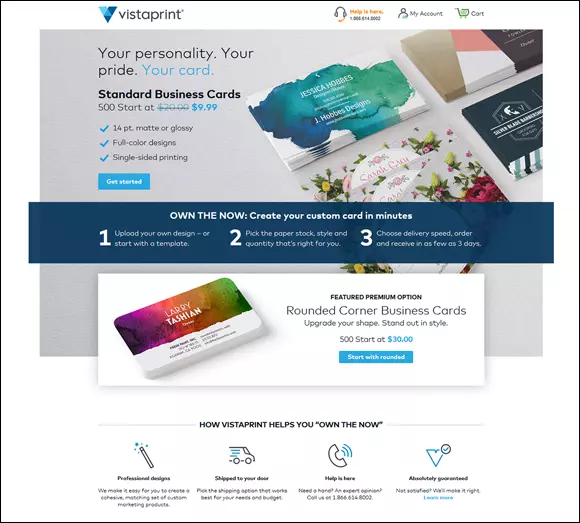
Vistaprint is the classic big box online printer. It has a huge catalog that runs from business cards and postcards to apparel, signage, and promo items. For business cards it is the default suggestion many people get from friends or Google. In our internal ratings for business cards, Vistaprint tends to land in the middle of the pack on quality and price, but near the top for templates and online tools.
Below we compare Printiverse vs Vistaprint business cards on quality, value, templates, service, tools, speed, and best use cases, based on our own test orders plus what real customers report.
Quality (material and print)
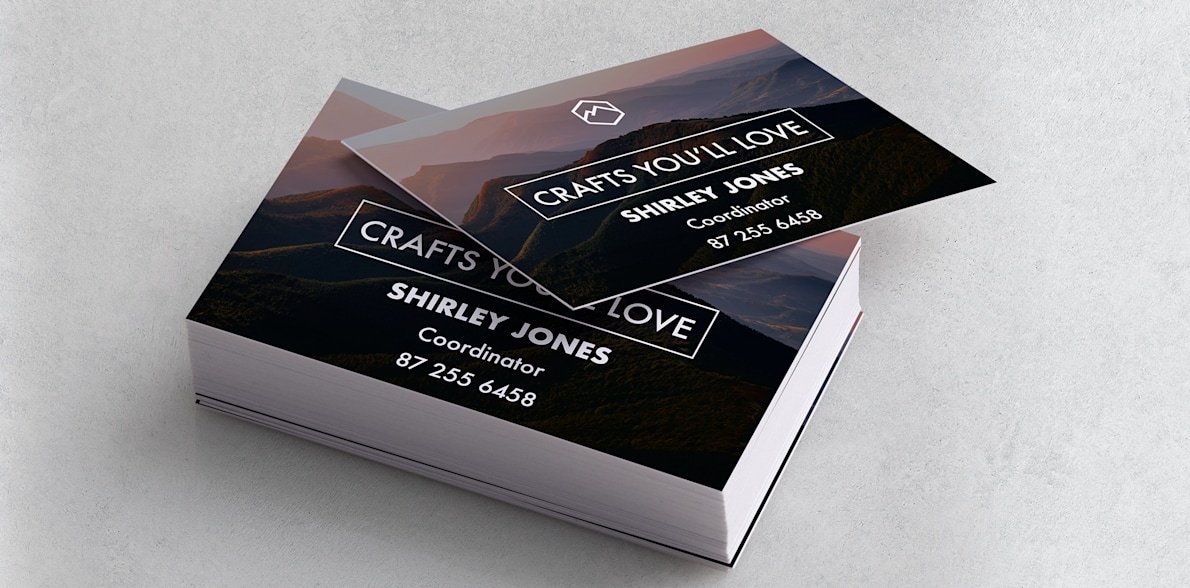
Printiverse positions itself as a quality upgrade over the big budget mills without going full boutique. On the card side, the platform offers a range of coated and uncoated card stocks, including glossy, matte, recycled, uncoated, soft touch, linen, pearl, bamboo, and hemp blend options in roughly the 13 to 18 point thickness range. Colors are vivid, line work is sharp, and the cards feel closer to what we expect from the better mid tier printers than from bargain business card packs.
In our testing, Printiverse lands at about 4 out of 5 for quality. Cards feel premium enough to impress clients or fans but not so delicate that you are afraid to toss a stack in your bag. You do not get every exotic stock under the sun, but you do get a solid mix of finishes that cover most real world business needs.
Vistaprint has invested a lot in card stocks over the last few years. The current lineup includes standard and premium business cards on 14, 16, and 18 point stocks, plus ultra thick 32 point cards, textured options like linen and recycled natural, and specialty finishes such as soft touch, pearl, metallic foil, and raised gloss. At the top end, the cards look and feel genuinely high quality.
The catch is that Vistaprint’s default cheap cards are still very common, and those are the ones many small businesses see first. They are acceptable but not exciting. Side by side with nicer stocks from other printers, standard Vistaprint cards can look a little thinner and flatter. When you pay for the better paper and finishes, Vistaprint’s quality rises into the same general band as Printiverse, but the baseline experience is more variable.
Price and value
Printiverse sits in the middle of the price spectrum. Entry level business card products start around ten dollars for small quantities, with pricing stepping down as you order more cards. For what you pay, you get card stocks that feel closer to premium than bargain, plus free online proofs, human review, and fast turnaround. In our scoring, that yields a 4 out of 5 on price and value. It is not the absolute cheapest, but the trade off of quality and service for the money is strong.
Vistaprint is more aggressive on headline pricing. Standard cards often start around ten dollars for fifty, and the company constantly runs sales and coupon codes that can drive real world prices down further. That is a big part of its appeal. At the same time, the upsell ladder for better papers, rounded corners, special finishes, and faster shipping can add up quickly. Once you configure a premium card the way you really want it, the gap between Vistaprint and a higher quality competitor narrows.
Taken together, we see Printiverse as the better value if you actually care about how the card feels and you plan to stay on reasonably standard options. Vistaprint is the better value if your main priority is minimizing cost on a basic card, especially when you can stack a big promo code on top.
Design templates and customization
Printiverse grew out of a card design platform that caters to trading cards, invitations, proxies, and other hobby products. That same design studio now powers business cards. You can start from artist made templates, drop in text, and tweak colors, or upload your own front and back designs. The tools include basic layout controls plus a curated color picker, and they are friendly enough for non designers, although the template library for business cards is not vast.
In our framework, Printiverse scores roughly a 3 out of 5 on templates and tools. It is much better than trade printers that only give you a PDF template and tell you to upload files, but it is not aiming to compete with the big marketplaces on template volume. If you already have a design or you like a smaller curated set of layouts, it is more than fine.
Vistaprint is still one of the strongest brands in the market on design templates and browser based customization. There are thousands of ready made business card designs organized by industry, style, and theme, plus a well refined editor that lets you upload logos, add QR codes, adjust fonts, and preview cards in 3D. For most non designers, this is the easiest way to get to a competent card quickly.
If your priority is having as many templates as possible and doing everything online, Vistaprint clearly wins this round. Printiverse’s tools are good enough, but they are not a template playground on the same scale.
Customer service
Printiverse leans hard on service as a differentiator. The marketing emphasizes free online proofs, human review, and fast responses if something looks off. Public facing copy and third party mentions describe quick turnaround on questions and a willingness to tweak files so the job prints correctly. In our internal scoring, Printiverse sits at the top of the multi product group on customer service and turnaround, with 5 out of 5 in both categories.
Vistaprint has a more mixed but generally positive reputation. On the plus side, there are a lot of Trustpilot reviews and customer stories that describe helpful live chat, quick reprints when orders arrive defective, and polite resolution when something goes wrong. On the minus side, there are also posts from customers who had defective products, struggled to get a refund, or were frustrated by policies around repeat complaints.
Overall, we rate Vistaprint as good but inconsistent on service. Most people have a fine experience, but when issues arise, it can be harder to get a truly satisfying resolution than it is with smaller, more hands on shops. Printiverse, by contrast, is set up to treat each order more like a premium job, which shows up in both our scores and external commentary.
Ordering experience and tools
On Printiverse, the card ordering flow feels like part of a unified card and sticker platform. You pick your product type, choose size and paper options, then either hop into the design studio or upload files directly. The interface focuses on a small number of clear choices rather than a long maze of upsells. You also see mentions of no minimums, free shipping over a certain threshold, and a best price guarantee that signals they aim to stay competitive without racing to the bottom.
Vistaprint’s workflow is familiar to anyone who has ordered business cards online. You either browse templates or upload your own design, then step through shape, paper, finish, quantity, and shipping. The editor is polished and there are many small touches like built in QR codes and sample kit options that help beginners. The flip side is that the site can feel busy, with lots of cross sells into other product categories. If you just want to buy cards and leave, that extra noise might be a bit much.
For pure card focused buyers, Printiverse feels more streamlined. For buyers who want to design cards, then also grab brochures, signs, and branded merch in a single session, Vistaprint’s big box feel is part of the appeal.
Turnaround time and shipping
Printiverse highlights fast turnaround as a core promise. Across its card products, the language emphasizes quick production, fast shipping, and efficient workflows that get cards printed and out the door in a few business days. Third party write ups and mentions also call out Printiverse as a faster, more responsive alternative to some larger shops. In our scores, that translates into a 5 out of 5 on turnaround among multi product printers.
Vistaprint offers multiple speed tiers, from slower economy to faster express options. On many business card products it advertises delivery as soon as tomorrow, depending on your location and chosen shipping method. In practice, most customers seem satisfied with timing, but there are occasional complaints when orders get delayed or shipping windows slip.
If you absolutely need cards by a specific date, both can work, but Printiverse’s smaller scale, hands on proofs, and top tier speed ratings make it easier to recommend when timing is tight and the job is important. Vistaprint is still strong on speed compared with the average printer, just not quite as differentiated.
Use cases and best for
Printiverse is best for:
- Small businesses and creatives that want business cards to feel more premium than budget printers without getting lost in a sea of exotic options
- Buyers who value responsive service, free proofs, and a human checking files before print
- People already interested in trading cards, proxies, or other card based products who like having everything on one platform
Vistaprint is best for:
- New businesses that want to design everything online and lean heavily on templates
- Buyers who are price sensitive and happy to chase promo codes to get the lowest possible cost on standard cards
- Companies that want business cards plus a broad range of related products like flyers, signage, and merch in one place
For a buyer who only cares about business cards and wants a quality bump with better support, we think Printiverse is a stronger default choice. For a buyer who wants a whole branded kit and values the convenience of a giant catalog and template library, Vistaprint still makes a lot of sense.
Pros and cons
Printiverse pros
- Card stocks and printing that feel premium compared with big budget rivals
- Strong service and fast turnaround, with free online proofs and human review
- No minimum quantities and clear, mid range pricing
- Unified platform for stickers, proxies, trading cards, and business cards
Printiverse cons
- Fewer exotic stocks and finishes than boutique card specialists
- Template library and online tools are good but not as deep as Vistaprint
- Brand is smaller and less well known, so there are fewer external reviews than legacy players
Vistaprint pros
- Huge template library and very approachable online editor
- Wide range of card stocks, shapes, and finishes including ultra thick and specialty options
- Frequent promotions and coupon codes that can make standard cards very cheap
- Large ecosystem of related print products in the same account
Vistaprint cons
- Default cheap cards look and feel more generic than premium competitors
- Quality and color consistency are more variable across orders and card types
- Service experiences range from excellent to very frustrating
- Easy to overspend once you start adding premium papers, finishes, and faster shipping
Final verdict
In a straight Printiverse vs Vistaprint business cards matchup, our recommendation is:
- If business cards are the main thing you are buying and you care about how they feel, how quickly they arrive, and how easy it is to fix problems, choose Printiverse. It offers higher perceived quality, stronger service, and less friction for a fair mid range price.
- If you are building a whole marketing kit, want to design everything online with a huge template library, and you are willing to accept more variation in card feel in exchange for rock bottom pricing during sales, Vistaprint still earns its place as the default big box option.
Both companies can deliver usable cards, but for most card focused orders we would lean toward Printiverse as the better balanced choice.