
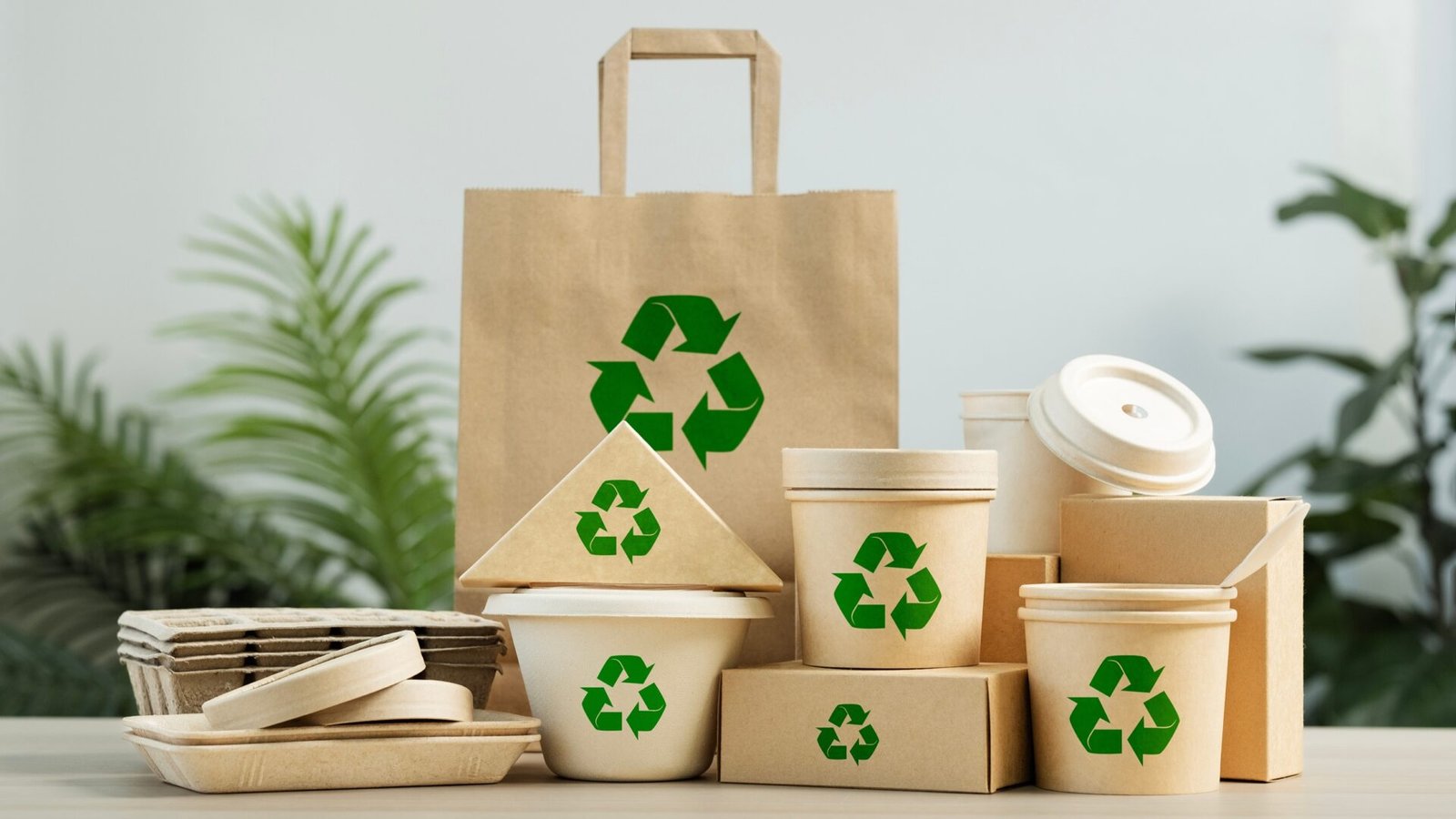
In print and packaging, lamination is one of those hidden choices that has a big impact. A thin film on top of your menu, postcard, or product label can protect it for months. It can also turn an otherwise recyclable piece of paper into something that’s hard to deal with at the end of its life.
“Eco laminate,” “bio laminate,” “biodegradable film” — these labels sound great. But they’re not all the same, and some of them promise more than they realistically deliver.
This article walks through what actually makes a print laminate more sustainable, what biodegradable plastic films really are, and where the limits and tradeoffs of “bio laminates” show up in the real world.
What is a print laminate, and why does it matter?
A print laminate is a thin film applied over a printed surface. You see it on:
- Menus and restaurant pieces
- Book covers, postcards, and business cards
- Product labels and flexible packaging
Printers use laminates to:
- Add durability and scuff resistance
- Change the look and feel (gloss, matte, soft-touch)
- Improve moisture and grease resistance
The problem is simple: most laminates are plastics bonded tightly to paper or board. That’s great for durability, but not great for recyclability. When you take a material that was easy to recycle (paper) and glue plastic on top, you often end up with a mixed material that is difficult to process in normal recycling streams.
So the core sustainability questions are:
- Do we need lamination at all for this job?
- If we do, can we choose a film or coating that has a lower footprint or better end-of-life options?
Traditional laminates: PVC, PET, and BOPP
For decades, laminates have mostly been:
- PVC (polyvinyl chloride) films
- PET (polyester) films
- BOPP (biaxially oriented polypropylene) films
PVC is tough and cheap, but it has a poor reputation from an environmental perspective. Production and disposal can release problematic substances, and PVC isn’t widely recycled in thin-film form.
PET laminates are common too. PET bottles are widely recycled, but thin PET films bonded to paper are a different story. Once glued to fiber, they almost never make it back into a clean plastic stream.
BOPP (polypropylene) has become the workhorse film for labels and flexible packaging. From a pure plastic-to-plastic comparison, PP films like BOPP tend to look better than PVC: they’re lighter, recyclable in dedicated PP streams, and often require less material to get similar barrier and clarity. Some suppliers also now offer BOPP laminates that include post-industrial (PIR) or post-consumer (PCR) recycled content, which can reduce virgin resin use and carbon footprint.
But even with BOPP, once the film is laminated to paper, it usually won’t be recycled as plastic. The best you can often hope for is that the paper fibers get recovered in a mill designed to tolerate some level of plastic contamination.
In other words: traditional laminates are still plastic, and the paper-plastic sandwich is the real bottleneck.
What “sustainable laminate” can mean
When you see terms like “sustainable laminate” or “eco laminate,” they can point to several different strategies. Some are genuinely helpful; some are just “less bad.”
Common moves include:
- Thinner films and optimized structures
Reducing film thickness cuts plastic usage directly. If a film is 20–30% thinner for the same performance, that’s a real material saving. - More recyclable base resins
Moving from PVC to PP (like BOPP or CPP) can reduce toxicity concerns and open up more recycling options for the plastic itself in monomaterial applications. - Recycled-content laminates
Laminates that include PIR or PCR content reduce demand for virgin resin. This doesn’t solve end-of-life problems on paper, but it does shift upstream impact. - Alternative films: PLA, PHA, and cellulose
Here’s where we get into “bio laminates”:- PLA (polylactic acid) films made from plant-based sources like corn or sugarcane and designed to be industrially compostable.
- PHA or PBAT blends used in some compostable packaging films.
- Cellulose-based films made from wood or plant fiber, often designed to be biodegradable, home-compostable, and compatible with paper recycling.
- Coatings instead of films
Sometimes, a water-based coating or varnish can provide enough rub resistance or gloss without adding a separate plastic film layer.
All of these can play a role. But they are not interchangeable, and their impact depends heavily on where and how the printed piece is used and disposed of.
Biodegradable plastic films: what they really are
“Biodegradable plastic film” is one of the most abused phrases in packaging. In practice, it usually refers to one of a few things:
1. Certified compostable films
These are films that meet specific standards like:
- ASTM D6400 / D6868 (often used in North America)
- EN 13432 (widely used in Europe)
These standards require the material to break down under controlled industrial composting conditions (high temperature, moisture, oxygen) within a set timeframe and without leaving harmful residues.
Typical examples:
- PLA-based films
- Some PBAT/PLA blends
- Certain compostable multi-layer laminates for pouches and bags
These films can make sense when:
- There is access to industrial composting that accepts packaging.
- The product and its contents are both suitable for composting (e.g., a compostable coffee bag used in a composting-aware market).
But if the film ends up in landfill or regular recycling, its “compostable” nature often doesn’t deliver much real-world benefit.
2. Biodegradable but not compostable
Some films are marketed as “biodegradable” without specific composting standards. These may:
- Break down only under certain conditions (like strong sunlight and heat).
- Fragment into smaller pieces rather than fully mineralizing.
- Take far longer to degrade than consumers would expect.
Regulators have become wary of this. In the U.S., the FTC’s Green Guides and some state laws restrict the use of “biodegradable” claims unless a product breaks down in a reasonably short time in the environment where it’s likely to end up. The EU is moving in a similar direction, pushing for clearer, evidence-based environmental marketing.
3. Home-compostable films
A smaller set of films are certified as home-compostable, meaning they break down in backyard compost conditions (lower heat, less control). Some cellulose films fall into this category. These can be closer to what people imagine when they hear “it just breaks down,” but they still require correct disposal and conditions.
Cellulose-based laminates: a promising but narrow tool
Cellulose films are usually made from wood pulp or other plant fibers. They behave more like very thin paper:
- They are derived from renewable resources.
- They can be designed to be biodegradable and home-compostable.
- Some grades are recyclable with paper, depending on coatings and adhesives.
- They offer decent clarity and barrier properties for certain uses.
In print, you’ll see cellulose-based laminates marketed under names that promise “eco” or “green” protection. Some products are pitched as a more sustainable alternative to traditional matte BOPP, with similar scuff resistance but better end-of-life pathways.
The catches:
- They may tear more easily in some applications.
- Heat-sealing windows and machinability need validation for each converting line.
- They can be more expensive and less widely stocked than standard films.
So they are promising, but not a universal drop-in replacement.
The limits and tradeoffs of “bio laminates”
This is the part that rarely makes it into marketing copy.
1. Infrastructure mismatch
Most biodegradable or compostable laminates are tested in controlled settings. Real-world waste systems are messy:
- Industrial composting facilities are not available everywhere.
- Many facilities do not accept compostable packaging at all, only food and yard waste.
- If a bio laminate goes into general recycling, it can contaminate streams designed for standard plastics or fiber.
Without matching infrastructure, the “bio” advantage is heavily diluted.
2. Mixed materials are still a problem
Even if the film itself is compostable:
- It may be bonded to non-compostable adhesives or inks.
- The underlying substrate (like a foil board or heavily coated paper) may not be compostable or recyclable.
A compostable film laminated to a non-compostable board doesn’t become a compostable product. The weakest link wins.
3. Performance tradeoffs
Bio laminates often have different characteristics than petroleum-based films:
- Different barrier properties to moisture, oxygen, or oils
- Different tear behavior or stiffness
- Narrower processing windows for sealing and converting
Sometimes that’s fine. Sometimes it means the product fails faster, the shelf life is shorter, or extra material is needed to compensate. That can offset some sustainability gains.
4. Greenwashing risk
If you label something “biodegradable” or “bio,” but in practice it:
- Takes many years to break down in real conditions, or
- Only breaks down in a type of facility that most customers don’t have access to,
you’re drifting into greenwashing territory. Regulators are already pushing back on vague environmental claims. Brands can face legal risk and reputational damage if they lean too hard on “bio” language without solid backing.
5. Cost and availability
Bio laminates are often more expensive and less widely available than standard BOPP or PET films. For high-volume print buyers, that can be a real barrier. For smaller runs, minimum order quantities and limited finish options can be the limiting factor.
How to choose laminates more responsibly
If you’re a print buyer, designer, or brand owner, here’s a practical way to think about it:
- Ask if you really need film lamination.
If the piece is short-lived or low-risk, a good uncoated stock or aqueous coating might be enough. - If you need film, start with the basics.
- Prefer non-PVC films where possible.
- Consider thinner films and BOPP or PP-based options with PCR/PIR content for general durability.
- Use bio laminates where they truly fit.
Compostable or cellulose-based laminates make most sense when:- You have a matching waste stream (industrial or home composting).
- The whole structure (film, adhesive, substrate) is designed with end-of-life in mind.
- Be honest in your claims.
If your laminate is “compostable only in industrial facilities,” say that. If it’s “cellulose-based and suitable for paper recycling under certain conditions,” say that. Avoid buzzwords you can’t back up. - Think in systems, not single ingredients.
A sustainable laminate in a non-recyclable, mixed-material pack is like a hybrid engine in a car that never leaves idle. You need the whole system — design, substrate, laminate, and disposal — to line up.
Conclusion
Sustainable laminates and biodegradable films are not magic fixes, but they are useful tools when you understand their limits. The biggest wins often come from:
- Avoiding unnecessary lamination
- Using lighter, more recyclable films when you do need lamination
- Choosing bio or cellulose-based laminates only where there is a realistic end-of-life path