
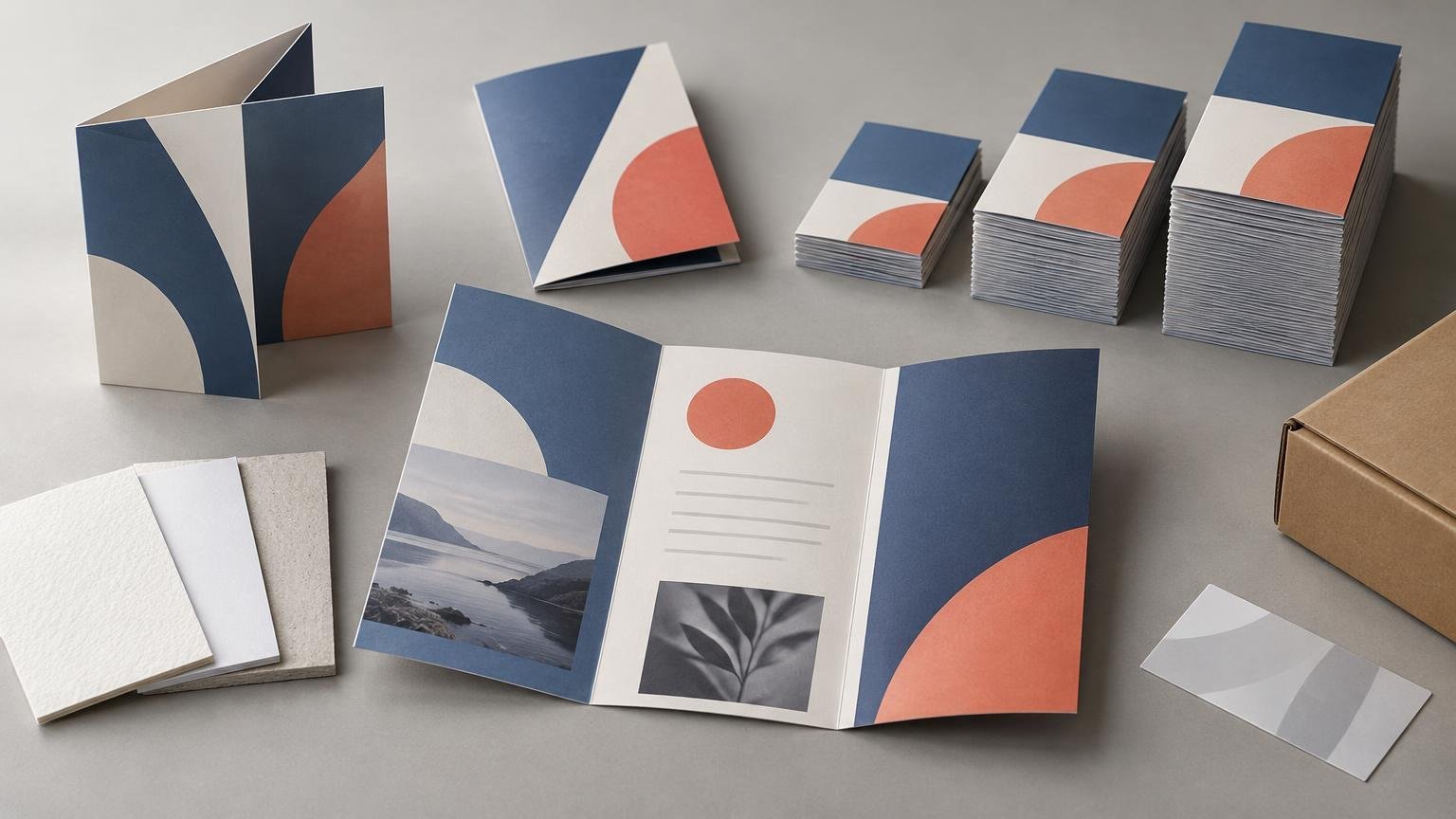
There is no useful universal price for brochure printing. The total depends on the brochure’s open and finished dimensions, run size, paper, fold, production method, schedule and delivery requirements. A cheap headline rate can also exclude artwork correction, proofs, shipping and mailing services.
The practical answer is to request matched quotes for one exact specification and compare the delivered total—not merely the advertised price per brochure. This is a research-based cost framework rather than a live vendor quote or hands-on print test.
What determines brochure printing cost?
A brochure quote normally combines several production and service costs. The GPO’s publishing alternatives guidance explains why quantity, dimensions, paper, schedule and production complexity all affect the final figure. It also distinguishes the front-loaded setup costs of offset printing from the lower setup requirements generally associated with short-run digital work. The point at which offset becomes economical depends on the job and equipment; there is no reliable universal crossover quantity.
| Cost factor | What changes the quote | Buyer consequence |
|---|---|---|
| Size | Open size, finished size and how efficiently the piece fits the press sheet | Unusual dimensions can increase waste or require more expensive handling |
| Quantity | Copies ordered and the production method used | The unit rate may fall while the total bill and surplus risk increase |
| Paper | Stock type, weight and coating | Paper changes appearance, handling and a meaningful part of the budget |
| Folding and finishing | Fold setup plus any special embellishments | Every added production step can introduce setup cost and waste |
| Schedule | Standard production versus compressed turnaround | Rush work may add fees, courier costs and production risk |
| Delivery | Shipping, fulfillment, mail preparation and postage | A low print price may represent only part of the campaign cost |
Run size changes unit cost, but more is not always cheaper
Offset printing carries prepress and make-ready costs that must be spread across the run. That can make its per-piece rate more attractive as quantity increases. Digital printing usually has less setup burden, making it a logical quoting option for shorter runs or projects where the content may change soon.
The familiar “buy more, save more” message is only partly true. A larger run can reduce the production rate per copy while increasing the amount paid today. Unused brochures can also create storage, fulfillment and obsolescence costs—especially when they contain prices, staff details, dates or offers likely to change.
Ask for at least three quantities using an identical specification. Compare the total cost, unit cost and realistic number of brochures you expect to distribute before the content becomes stale. Ordering 5,000 pieces is poor value if 3,000 end up in a recycling bin.
Paper can consume a substantial share of the budget
The GPO’s print cost-control guidance estimates that paper can represent 20% to 40% of a print job’s cost. That makes stock selection more than a cosmetic upgrade. Coated and uncoated papers offer different visual and handling characteristics, but neither is automatically necessary for every brochure.
When comparing paper options, request the precise stock rather than accepting labels such as “standard,” “premium” or “heavy.” Ask for the paper type, weight, coating and finish. A heavier or more elaborate stock may support a high-value presentation, but it can be wasted on a short-lived handout where readability, fold quality and low distribution cost matter more.
Standard dimensions can also reduce waste by fitting efficiently on common parent sheets. GPO identifies 8.5 × 11, 5.5 × 8.5, 6 × 9 and 9 × 12 inches as examples of cost-efficient sizes, while unusually large or small formats can require slower finishing. If you are still selecting a supplier, our flyer and brochure printer guide covers workflow and specification differences worth checking.
How folds and special finishes affect the price
Folding is a bindery step, so it should appear clearly in the specification and quote. The printer needs both the open size and the final folded size, along with the fold pattern. “Tri-fold brochure” alone may leave too much room for assumptions about panel layout, dimensions and paper.
Additional finishing requires production setup and can create setup waste. Foil stamping, embossing, die-cutting, numbering, extra ink colors and varnishes are among the treatments GPO identifies as cost additions. Pay for them when they support a concrete purpose, such as navigation, brand presentation or response—not simply because the ordering page calls them premium.
For custom dimensions or less familiar production combinations, comparing broader custom printing options can help clarify what belongs in the base product and what requires separate finishing. Always obtain a proof or folding template appropriate to the selected printer before approving the run.
Costs commonly omitted from the headline price
A brochure’s displayed print price may not include design, file repair, layout correction, prepress, proofing, rush production or shipping. Prepress and proofing can be separate initial expenditures, particularly in offset workflows. A deadline also has two parts: production and transit. Our guide to production time versus shipping time explains why a fast press schedule does not guarantee an equally fast delivery.
- Artwork or design fees
- File inspection and repair
- Digital or physical proofs
- Folding and special finishing
- Rush production or courier charges
- Freight or parcel shipping
- Warehousing and fulfillment
- Mail preparation, address data and postage
Use a simple comparison formula: print plus setup and finishing plus proofing plus shipping plus distribution equals the usable project total. Request tax and any expected overage policy as separate line items where applicable. This prevents a low base price from winning against a quote that includes more of the work.
Direct-mail brochures need a separate campaign budget
Postage is not part of printing unless the quote explicitly bundles it. Mailing preparation, distribution and postage should remain separate line items. For a fuller breakdown, see our guide to direct-mail printing costs.
The supplied USPS Every Door Direct Mail page lists EDDM Retail postage at $0.247 per eligible piece up to 3.3 ounces and entry through a Business Mail Entry Unit as low as $0.242 per piece. At the listed retail rate, postage alone equals $247 for 1,000 pieces or $1,235 for 5,000 pieces. Those figures exclude printing, artwork, lists and mail preparation, and postal rates should be checked again before ordering.
Eligibility matters too. USPS rules in the cited schedule require at least 200 pieces or 50 pounds for EDDM Retail, cap submissions at 5,000 pieces per day per five-digit ZIP Code, and impose weight and flat-size requirements. The service uses simplified addressing and does not include guaranteed delivery timing, forwarding or return service.
How to request a brochure quote you can trust
Send every printer the same specification: open and folded size, quantity, print sides, color requirements, exact paper, coating, fold pattern, proof type, delivery postcode and required arrival date. Ask whether the price includes file checks, folding, packing and shipping.
Then compare two or three sensible quantities and one restrained paper alternative. The best-value brochure is not automatically the cheapest unit or the thickest stock. It is the configuration that delivers the required appearance, arrives on time and produces the number of usable pieces you can realistically distribute.
References
- GPO White Paper: Publishing Alternatives for Federal Communication Projects
- Tips for Controlling Cost on Your Printing Communication Projects
- Every Door Direct Mail (EDDM) – Targeted Mail Marketing | USPS
- 140 | Postal Explorer