
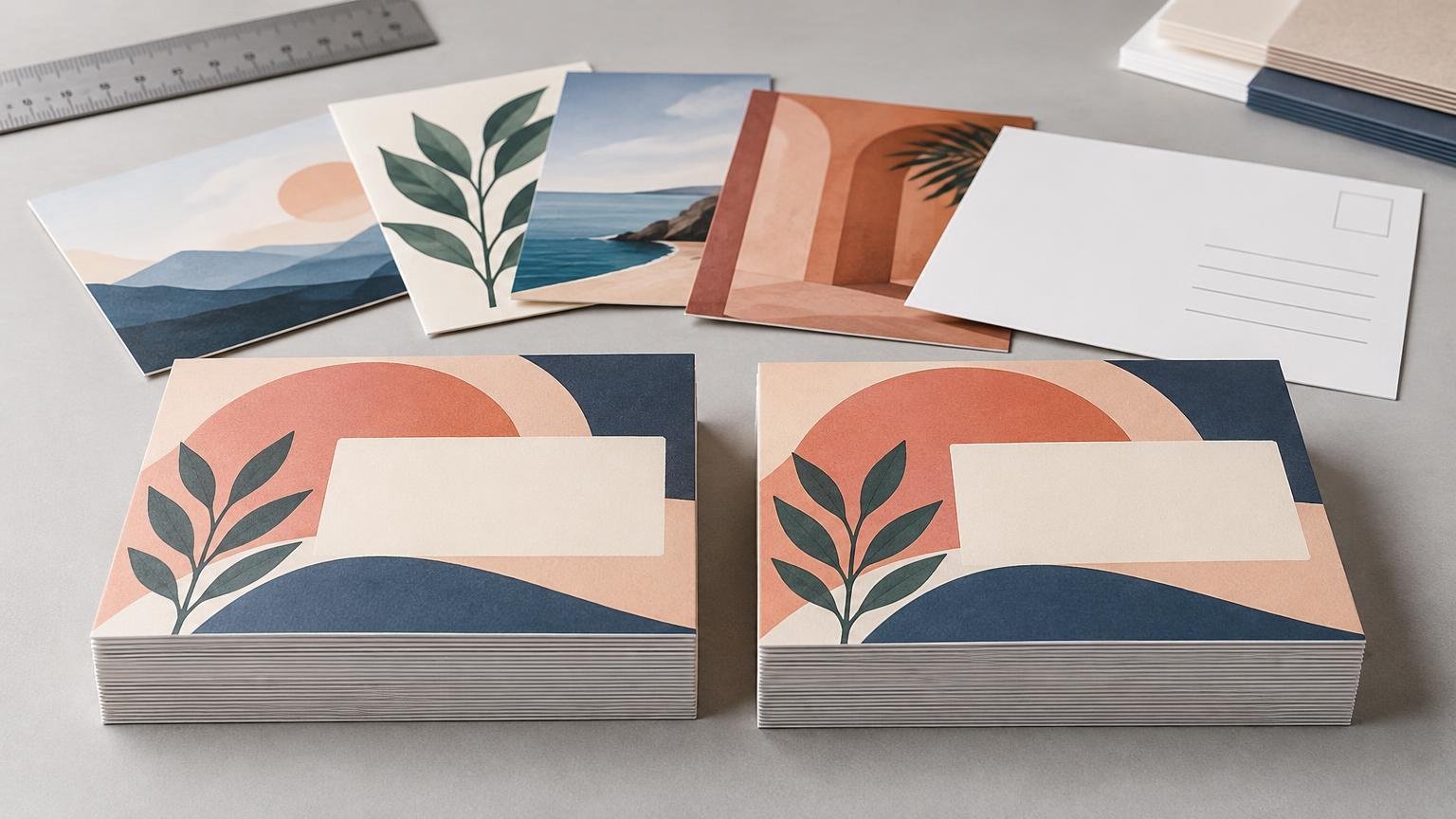
For most buyers comparing UPrinting vs 48HourPrint postcards, the practical split is straightforward: UPrinting publishes the broader range of sizes, stocks, finishes and quantities, while 48HourPrint emphasizes a qualifying 48-business-hour production-to-shipment option and a defined list-based direct-mail workflow. Neither company can be called the better value without matching the exact card, quantity, shipping destination and mailing service.
There is also not enough documented sample evidence in the current record to name a physical print-quality winner. A responsible UPrinting vs 48HourPrint postcards verdict must connect any claim about color, trimming, coating or damage to the tested cards. The recommendations below therefore separate current published capabilities from the hands-on findings that still need to be entered into the comparison.
UPrinting vs 48HourPrint postcards at a glance
| Decision factor | UPrinting | 48HourPrint | Practical consequence |
|---|---|---|---|
| Standard sizes | Nine published sizes plus custom sizing | Multiple standard postcard formats, but the supplied evidence does not establish a complete current size list | UPrinting is the clearer choice when the job requires an unusual trim size. |
| Stock and finish range | Options from 10 pt. through 17 pt., including uncoated, UV-front/uncoated-back, fine-grit, silk and soft-touch choices | Published options include 14 pt. and 16 pt. gloss or matte, plus high-gloss and UV-front/uncoated-back configurations | UPrinting publishes more specialty choices; 48HourPrint covers common coated postcard configurations. |
| Standard quantity range | 25 to 100,000 | Not reliably established by the supplied research | Verify the 48HourPrint cart rather than assuming its direct-mail minimum applies to print-only cards. |
| Published production language | One-, two- or three-business-day choices on standard postcards | Qualifying orders ship 48 business hours after proof approval | Neither statement is a delivery guarantee; proof timing and transit still matter. |
| List-based direct mail | Direct mailing is available from 250 pieces | Accepts customer lists or offers list rental, processing and USPS handoff | Compare list work, mail preparation, postage and fees separately from printing. |
| EDDM | Print-only and full-service paths | Print-only and fuller-service paths | The responsibility for routes, paperwork, bundling, postage and USPS delivery depends on the selected service. |
UPrinting has the broader published configuration menu
UPrinting’s standard postcard page lists nine sizes: 3.5 x 8.5, 4 x 6, 4.25 x 6, 4 x 9, 5 x 7, 5.5 x 8.5, 6 x 8, 6 x 9 and 6 x 11 inches. It also offers custom sizing. Published quantities run from 25 to 100,000. That combination makes UPrinting easier to shortlist for small test runs, unusually proportioned cards or campaigns that may scale into high quantities.
Its material menu is also more varied on paper. UPrinting lists 10 pt. gloss and matte choices, several 14 pt. configurations, 16 pt. specialty finishes and 17 pt. uncoated stock. Notable options include UV coating on the front with an uncoated back, as well as fine-grit, silk and soft-touch finishes.
Those options solve different problems. An uncoated back is useful when recipients or staff need to write on the card. A gloss or UV-coated face can make color and photographs look more polished, but glare may reduce readability under strong light. Soft-touch and textured finishes can create a more distinctive tactile result, although their value depends on the campaign. Paying extra for a specialty surface is difficult to justify when the card is a short-lived coupon or high-volume mailer.
48HourPrint’s published standard-postcard materials cover common commercial choices: 14 pt. gloss, high gloss, high-gloss UV on the front with an uncoated back, and 16 pt. gloss or matte. Its dedicated direct-mail postcard configuration is described as 14 pt. cardstock with several coating choices. That is enough flexibility for many promotional cards, but it does not match the breadth of UPrinting’s published specialty-finish menu.
The menu winner is therefore UPrinting, not necessarily the print-quality winner. A longer stock list says nothing by itself about color accuracy, trim consistency or coating durability. Those outcomes require comparable physical samples.
How the physical postcards should be judged
A valid sample comparison starts with equivalent products. Both cards should use the same finished dimensions, artwork, printed sides and broadly comparable stock and coating. Comparing a heavy matte card from one printer with a lighter high-gloss card from the other mostly measures the specification choices, not production quality.
The hands-on record should address the following points before either printer is awarded a quality win:
- Fine text and reversed type: inspect small lettering for fill-in, broken strokes or fuzzy edges.
- Color and neutrals: compare skin tones, brand colors, gray balance and dark areas under the same lighting.
- Solids and gradients: look for banding, uneven coverage, mottling or abrupt tonal transitions.
- Registration and trimming: check whether borders remain even and whether front-to-back alignment is acceptably consistent.
- Stock feel: distinguish actual stiffness and surface character from the nominal point specification.
- Coating performance: examine glare, scuff visibility, fingerprints and whether an uncoated writing area accepts the intended pen or marker.
- Packaging and delivery condition: record bent corners, rubbing, moisture exposure, loose bundles or other transit damage.
A result in one category should not be stretched into a universal verdict. One printer might reproduce small type more cleanly while the other delivers more accurate trimming or a less scuff-prone surface. The best choice depends on whether the card is image-led, text-heavy, writable or intended to feel unusually substantial.
Turnaround claims are not delivery promises
UPrinting lists one-, two- and three-business-day production choices for standard postcards. 48HourPrint states that qualifying postcard jobs ship 48 business hours after proof approval. In both cases, the relevant clock concerns production rather than the date the package reaches the buyer.
Buyers working toward a fixed event should read the production promise together with the shipping service rather than treating the fastest displayed number as an arrival date. The distinction is covered in more detail in this guide to production time versus shipping time in printing.
48HourPrint has the clearer use-case advantage when a selected configuration expressly qualifies for its 48-business-hour production-to-shipment window and that schedule fits the project. UPrinting may offer a shorter published production choice on some standard postcard configurations, but the final decision still depends on proof timing, shipping and the date shown in the live cart.
Delivered value requires a matched cart
A base print price is not a complete comparison. Postcard quotes should be normalized by finished size, quantity, printed sides, stock, coating, production speed and destination ZIP code. Promotions should either be applied to both orders or shown separately from regular pricing.
Record these cost lines independently:
- Printing price after configuration choices
- Special finish or production-speed charges
- Shipping
- Tax
- List acquisition or processing
- Addressing and presort work
- Administrative or postage-handling fees
- Postage
This matters especially for mailing campaigns. A printer can have the lower print subtotal and still produce the higher campaign total after data work, preparation fees, postage handling and shipping are included. For a reusable quote worksheet and an explanation of each cost category, see how direct-mail printing costs are structured.
Useful cart checks would include a small run such as 100 or 250 print-only cards, a 1,000-card standard order and a 2,500-to-5,000-piece mailing. Each scenario answers a different question. A low-quantity winner may lose its advantage at a larger price break, while a mail-service quote may include labor that a print-only quote leaves to the buyer.
Without equivalent live carts, there is no supportable overall price winner. If neither catalog fits a specialized card project, it may also be useful to compare other custom printing options, but apply the same matched-specification and delivered-cost test.
Direct mail and EDDM are separate comparisons
Ordinary postcard printing, list-based direct mail and Every Door Direct Mail are different purchases. A print-only card order produces cards. A list-based campaign adds recipient data, addressing, presort and postal handoff. EDDM targets carrier routes rather than a conventional named-recipient list and has its own preparation requirements.
List-based direct mail
48HourPrint says it can process a customer-supplied list or provide list rental. Its listed functions include CASS certification, inkjet addressing, presort and USPS handoff. The company publishes an $85 per-list processing fee and a 5% administrative or handling fee on postage transactions. These are time-sensitive charges that should be confirmed in the current quote.
For direct-mail orders of 10,000 pieces or fewer, 48HourPrint states that the job is dropped at USPS four business days after proof approval. It lists seven business days for larger orders. That is a handoff schedule, not an in-home delivery date.
UPrinting states that direct mailing is available from 250 pieces. The better service depends on the actual list, quantity, processing requirements and complete campaign quote—not simply the print price.
EDDM
UPrinting describes both print-only and full-service EDDM. Its full-service path includes route and date selection, printing, processing and delivery to the post office. With print-only service, USPS setup, paperwork, postage, bundling and post-office delivery remain the buyer’s responsibility.
48HourPrint also presents print-only and fuller-service EDDM workflows. Before comparing prices, identify exactly who is handling route selection, paperwork, bundling, postage and postal delivery. A service that includes those tasks is not directly comparable to a box of printed cards.
For a broader vendor view, the related guide to postcard printing companies for EDDM and direct mail compares the campaign-level considerations beyond these two providers.
Check USPS dimensions before choosing a size
“Postcard” is a printing product name, but USPS postcard pricing has narrower dimensional rules. USPS says a postcard-price mailpiece must be rectangular, at least 3.5 by 5 inches and 0.007 inch thick, and no larger than 4.25 by 6 inches and 0.016 inch thick. A 4 x 6 card can fit within those dimensions if it satisfies the other applicable requirements. A larger printed postcard may still be mailable, but it does not qualify for postcard pricing.
Buyers should verify the current requirements through the USPS postcard size guidance before approving artwork or ordering stock. A seemingly minor size change can alter the applicable mail category and campaign cost.
EDDM sizing is different again. USPS guidance treats eligible EDDM-Retail pieces as flats that exceed at least one letter-size maximum, with permitted dimensions extending up to 15 by 12 by 0.75 inches. Do not assume that a small postcard-price piece automatically qualifies for an EDDM configuration or that a large EDDM mailer receives postcard postage.
Which printer should you choose?
Choose UPrinting first when configuration flexibility drives the job. Its published range is stronger for custom sizing, very small or very large quantities, uncoated choices and specialty finishes such as silk, soft touch and fine grit. It is also the clearer catalog starting point when you need a writable back paired with a coated front.
Choose 48HourPrint first when the selected product qualifies for its stated 48-business-hour production-to-shipment window or when its list-based mailing workflow matches the campaign. Confirm proof deadlines, shipment timing, list charges, postage handling and the expected USPS handoff date before ordering.
Do not choose either printer solely from an advertised unit price. Build equivalent carts and compare the amount charged through delivery—or through postal handoff for a mailing campaign. For print quality, enter the actual matched-sample observations before declaring a winner. Until then, the defensible verdict is that UPrinting leads on published postcard configuration breadth, while 48HourPrint offers a clearly described fast-production and direct-mail path for qualifying jobs.
References
- Sizes for Postcards | Postal Explorer
- Quick Service Guide
- Postcard Printing – Custom Postcards in 1 Day | UPrinting
- Postcard Printing | Print Postcards | 48HourPrint.com
- Direct Mail Postcard Printing – Fast Print Turnaround | 48HourPrint
- Custom Postcard Printing | Tips & Resources | 48HourPrint.com
- (Reviews Page 11) EDDM® Postcard Printing and Mailing Services – Postcard Mailing | UPrinting