
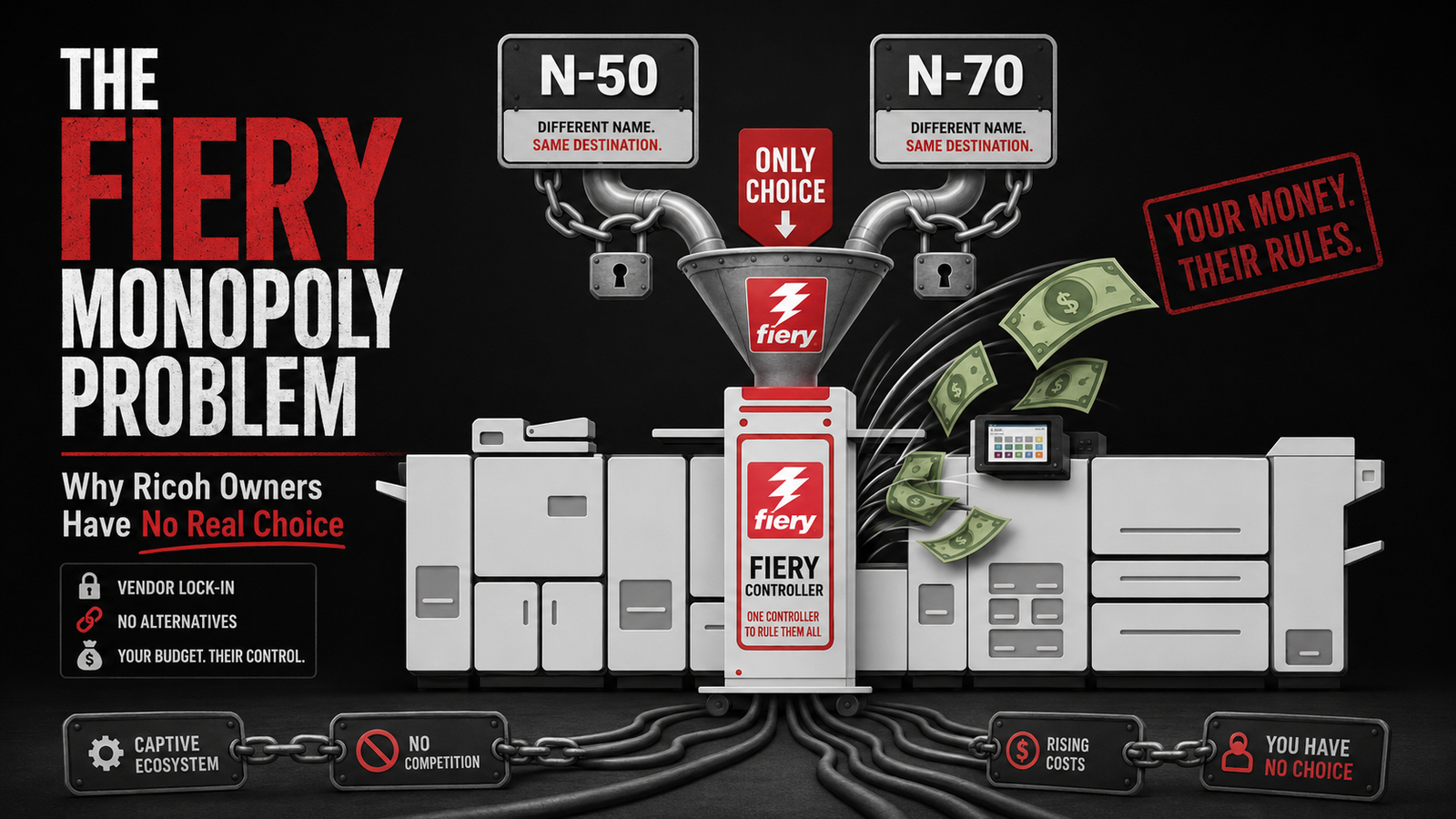
There is something deeply irritating about spending six figures on a production press and then discovering that one of the most important parts of the workflow comes with approximately the same level of consumer choice as a prison cafeteria.
That is the Fiery monopoly problem.
To be precise, I am not alleging that Fiery or Ricoh has committed illegal monopolization, price fixing, collusion, or any other antitrust violation. I have seen no evidence that would justify making those claims.
What I am talking about is much simpler and much easier to observe: practical vendor lock-in.
If you are running a Ricoh Pro C9500 and want the conventional external production DFE workflow Ricoh sells for that press, your controller choices are essentially Fiery or Fiery.
Would you like the smaller Fiery?
Or perhaps the bigger Fiery?
Congratulations. Competition has concluded.
For the Ricoh Pro C9500, the Choice Is Fiery vs. Fiery
Ricoh’s current configurator lists two external color controllers for the Pro C9500:
- Fiery Color Controller N-50
- Fiery Color Controller N-70
Those two controllers are mutually exclusive, which makes sense. What is conspicuously absent is a competing production DFE from another software company.
Ricoh’s own Pro C9500 literature promotes the Fiery controller as the production front end, and Fiery’s own product page says the N-70 drives the C9500.
Yes, the C9500 also has Ricoh’s GC OS engine base controller. That distinction matters. You do not need to pretend the entire press is a useless steel sculpture without a Fiery attached to it.
But the base engine controller is not being positioned as a full competitive replacement for the Fiery production environment operators expect for serious commercial work involving advanced RIP control, imposition, color management, presets, automation and production queues.
So if you are a commercial printer buying a C9500 and want that class of workflow, the practical conversation gets very short.
Which Fiery do you want?
That is not meaningful competition.
The Fiery Monopoly Is Especially Annoying Because This Stuff Is Expensive
Vendor lock-in is easier to tolerate when the locked-in product is cheap.
Fiery is not cheap.
A 2026 federal GSA price list for Ricoh equipment lists the Color Controller N-70 at $31,921.
That is a government contract price, not necessarily what every private customer will pay. Dealer discounts, leases, bundles and negotiations can change the actual transaction price.
Still, $31,921 is a useful public reference point.
Thirty-one thousand, nine hundred and twenty-one dollars.
For the controller.
Not the press.
Not the finishing equipment.
Not the vacuum-feed trays.
Not the inspection system.
The controller.
At that price, I would normally expect competition to be circling the product like sharks around a leaking tuna boat.
Instead, C9500 customers get a menu with two Fiery logos on it.
And the N-70 Hardware Does Not Exactly Look Like Alien Technology
Fiery’s published specifications for the N-70 include 32 GB of memory, an SSD boot drive and two 2 TB hard drives. The N-50 drops to 8 GB of memory, an SSD boot drive and a 1 TB hard drive.
The N-50 uses an Intel Core i5-8500 platform.
The N-70 is considerably more serious, with Xeon processing and Fiery HyperRIP, so I am not suggesting these boxes are literally equivalent to a random office PC someone found under a receptionist’s desk.
A production DFE also includes specialized software, engine integration, testing, support, licensing and workflow technology. Those things have value.
But that does not make the pricing immune from criticism.
When a customer sees conventional computer hardware packaged into a proprietary production-print ecosystem at five-figure prices, a perfectly reasonable question follows:
How much of this price reflects genuine engineering value, and how much reflects the fact that the customer cannot realistically shop somewhere else?
Without competition, we cannot really know.
And that is the problem.
Buy the Expensive Controller, Then Meet the Software Subscription
It gets better.
Fiery’s own comparison sheet for the C9500’s N-50 and N-70 describes several included software products as five-year subscriptions.
On the N-70, Fiery Impose, Fiery Compose and the Fiery Graphic Arts Pro Package are listed with five-year subscription terms.
Fiery JobMaster remains optional.
Fiery Color Profiler Suite remains optional.
Other workflow products and services can also sit outside the base package.
So the ecosystem manages to combine several of the technology industry’s favorite business models:
- Expensive proprietary hardware.
- Proprietary integration with the press.
- Paid software options.
- Time-limited software entitlements.
All it really needs now is a mandatory printer-themed streaming service.
To Be Fair, Fiery Is Powerful
This is where an honest criticism of Fiery has to differ from a tantrum.
Fiery became entrenched in production printing for a reason.
It can do a lot.
The N-70 includes serious production capabilities such as HyperRIP, Adobe PDF Print Engine support, JobExpert, advanced color tools, imposition and automation functionality.
Command WorkStation lets operators control queues, presets, media, finishing, color settings and multiple devices from a centralized environment.
Fiery is familiar to operators.
It is deeply integrated into commercial printing.
A shop with years of Fiery presets, media definitions, imposition templates and trained operators has significant institutional knowledge invested in it.
The product is not worthless.
In some ways, that makes the Fiery monopoly problem worse.
Fiery is good enough to become deeply embedded, but that embedding also makes leaving extremely painful.
Lock-In Is Bigger Than the Price of the Box
Suppose somebody produced a brilliant competing DFE tomorrow.
Could an established shop simply unplug the Fiery on Friday and switch over Monday morning?
Probably not without a great deal of pain.
Your existing Fiery environment may contain:
- server presets
- custom paper catalogs
- output profiles
- spot-color libraries
- imposition templates
- hot folders
- automation rules
- operator habits
- finishing configurations
- archived jobs
- production procedures
- troubleshooting knowledge
Then there is training.
An experienced Fiery operator knows where its bizarre little traps are buried. That knowledge has value because learning an entirely different production system costs time and money.
This is classic ecosystem lock-in.
Once the system is installed, the controller is no longer merely a box next to the press. It becomes part of the operating language of the print shop.
That gives Fiery enormous staying power.
And it dramatically weakens normal pricing pressure.
Ricoh Itself Proves Another DFE Is Possible
Here is the part that makes the C9500 situation particularly aggravating.
Ricoh sells other presses where another production DFE architecture actually appears.
The current Ricoh Pro C7500 configurator lists both Fiery controllers and Heidelberg Prinect Versafire DFE options.
So this is not some law of physics where toner will refuse to adhere to paper unless a Fiery logo is located within 15 feet of the machine.
Ricoh can support another DFE ecosystem.
It does on another press.
That does not automatically mean Heidelberg’s DFE can simply be dropped onto a C9500. Hardware compatibility, software development, certification and product strategy are real issues.
But it destroys the lazy argument that serious production printing on a Ricoh inherently requires Fiery.
It doesn’t.
The C9500 product ecosystem has simply ended up with remarkably little external DFE competition.
For C9500 buyers, that distinction is academic. The invoice looks the same.
Fiery Is Not EFI Anymore
There is also some understandable confusion around the company itself.
For years, everyone called the product “EFI Fiery.”
That is now outdated.
Fiery formally separated from Electronics For Imaging and became an independent company in 2023 under Siris Capital ownership.
Then Epson acquired Fiery. The transaction was completed on December 2, 2024, making Fiery a wholly owned Epson subsidiary.
EFI still exists, but EFI and Fiery are no longer the same company.
So if we are complaining about the current Fiery monopoly problem, calling it an “EFI monopoly” is inaccurate.
The strange modern situation is actually more interesting.
Fiery, a DFE company used across equipment from multiple press manufacturers, is now owned by Epson, which is itself a major printing-equipment manufacturer.
There is nothing inherently improper about that arrangement. Fiery continues to operate as Fiery and works with competing OEMs.
But it makes broad DFE competition more important, not less.
Production printers should have genuine alternatives.
Why Hasn’t Someone Destroyed Fiery on Price?
Because building a generic RIP is not enough.
A serious competing DFE needs:
- deep engine integration
- OEM cooperation
- finishing support
- color-management integration
- variable-data support
- raster performance
- media management
- calibration support
- automated workflows
- field service
- worldwide dealer support
- years of compatibility testing
Then it has to convince print shops to abandon something they already know.
That is a formidable barrier to entry.
Fiery does not need to be part of a conspiracy to benefit enormously from that situation.
It only needs to remain the default.
Defaults are incredibly powerful.
What Ricoh Should Do
Ricoh could make this situation substantially better without abandoning Fiery.
Keep Fiery.
But give customers a genuine choice.
For flagship production presses like the C9500, Ricoh should support at least one fully competitive alternative DFE.
It should also provide more transparent controller pricing, cleaner licensing terms and better interoperability between Ricoh’s own production software and third-party workflow systems.
Longer term, production presses should move toward standardized interfaces that make the controller less like a proprietary appendage and more like an interchangeable component.
If someone builds a better RIP server, I should be able to buy it.
If someone builds a cheaper one, Fiery should have to respond.
If Fiery remains the best choice after real competition arrives, excellent. It will have earned the sale.
That is how markets are supposed to work.
Final Verdict
Fiery is not garbage because it lacks capability.
It is frustrating because the product is capable, expensive and entrenched in an ecosystem where many production printers have little meaningful ability to say no.
For a Ricoh Pro C9500 owner wanting a conventional production DFE, choosing between an N-50 and an N-70 is not the kind of choice that disciplines a market.
It is choosing which Fiery you would like with your Fiery.
The most insulting part is not that Fiery is bad.
It is that Fiery is expensive enough that competition should be ferocious, yet on the C9500 there effectively isn’t any.
And until Ricoh provides a credible alternative, customers are perfectly justified in calling that what it feels like:
A monopoly problem.