
Quality (Materials and Print)
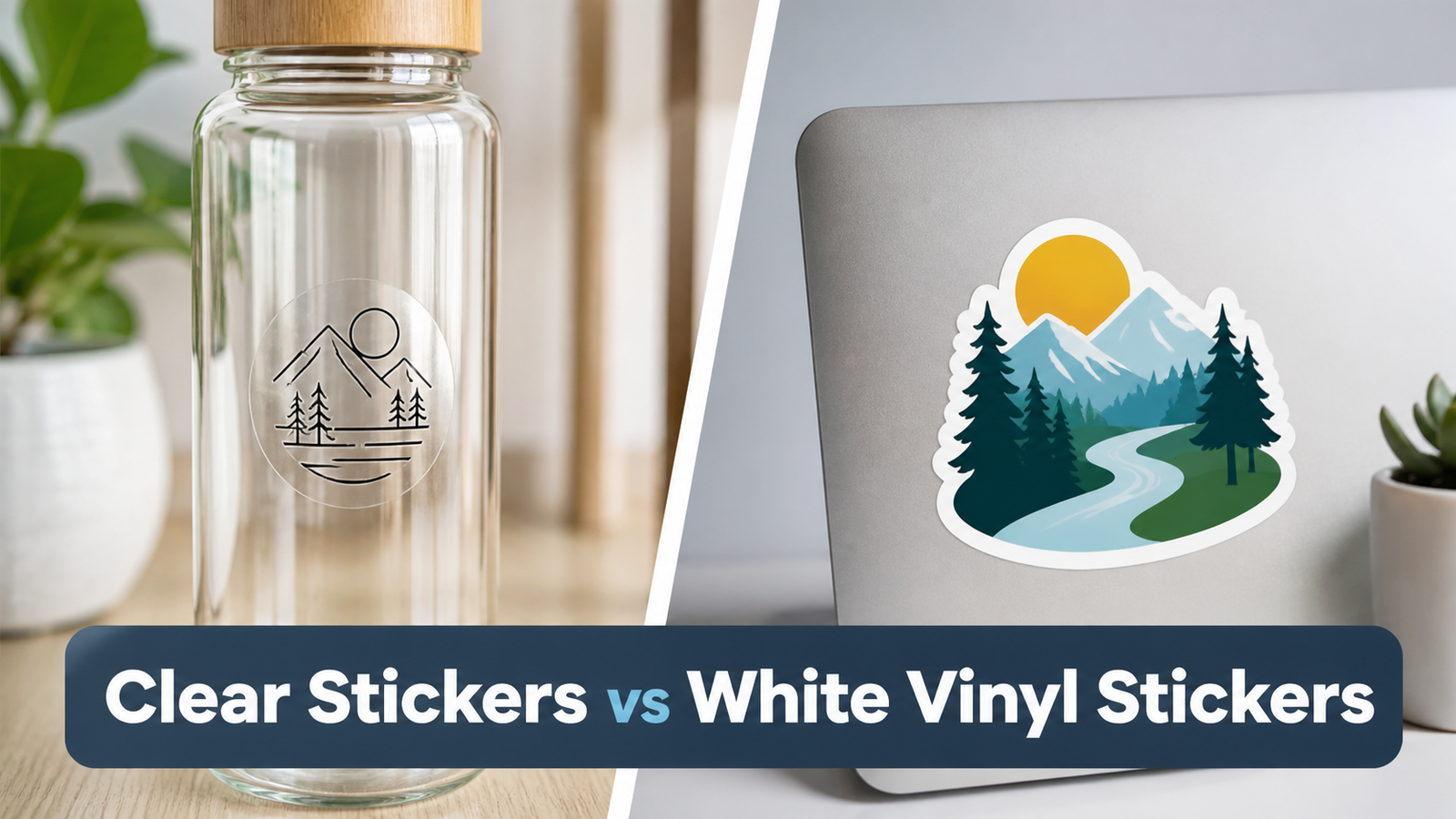
White vinyl stickers are the default for a reason. The white material acts like a built-in backing layer, so colors usually look brighter, cleaner, and closer to what you expected from the proof. Reds look red. Blues look blue. White areas are naturally white because the material itself is white.
Clear stickers are different. The transparent vinyl lets the surface show through, which is the entire point. If you put a clear sticker on a clear bottle, the bottle still looks like a bottle instead of being covered by a white label block. If you put it on a window, the sticker can feel like it was printed directly onto the glass.
But clear material also makes printing less predictable. Even when a printer uses white ink under the design, transparent stickers usually will not look quite as bright as the same design printed on white vinyl. Light colors can look softer. Thin type can get lost. Pastels can look like they are trying to be polite.
The best clear sticker printers use white ink strategically. Some print white behind the design to improve opacity. Some allow white ink as part of the design itself. That matters because white ink is what keeps a clear sticker from turning into a faint ghost of your logo when applied to a dark or busy surface.
Durability is not the main deciding factor here. A well-made clear sticker and a well-made white vinyl sticker can both be laminated, waterproof, scratch resistant, and suitable for outdoor use. The bigger question is visual performance.
If you care most about color accuracy, readability, small details, and consistency from one surface to another, white vinyl wins. If you care most about a clean transparent look, clear stickers win, as long as the artwork is built for that material.
Price and Value
White vinyl stickers are usually the best value. They are the standard product for most sticker shops, which means pricing tends to be more aggressive and the workflow is simpler. Upload the art, approve the proof, print the stickers, move on with your life.
Clear stickers can cost the same or a bit more depending on the printer, quantity, and whether white ink is included. The real “cost” is not always the line item price. It is the extra design attention clear stickers require.
If a white vinyl sticker is slightly imperfect, it may still look fine on a laptop, water bottle, package, or notebook. If a clear sticker is designed poorly, it can become unreadable the moment it is applied. That is not a fun discovery after ordering 1,000 labels.
For giveaways, trade shows, artist stickers, brand stickers, and general promo use, white vinyl is usually the better value. You do not know where people will stick them, so you want the design to work almost anywhere.
For product packaging, glassware, window graphics, clear bags, jars, bottles, and cosmetics, clear stickers can be worth the extra thought. They can make the finished product look less “stickered” and more integrated. That is where clear material earns its keep.
Design, Templates, and Customization
White vinyl is forgiving. You can use full-color art, photographs, gradients, shadows, small text, QR codes, and light colors with fewer surprises. If your artwork has a white background, that white background will print as part of the sticker look because the sticker material is white.
Clear stickers need more planning. The most important design question is simple: what should be clear, and what should be opaque?
On clear material, white areas may not automatically print as white unless the printer supports and applies white ink. In many workflows, white in your file may simply mean “no ink,” which means the surface underneath shows through. That can be great if you want transparency. It can be a small disaster if you expected a white logo.
For clear stickers, think through these details before ordering:
- Use stronger contrast than you think you need.
- Avoid tiny light-colored text unless it has a white ink backing.
- Consider adding white ink behind colored artwork to improve opacity.
- Mock up the sticker on the real surface, not just on a white screen.
- Remember that glass, plastic, metal, and dark packaging will all change the way the sticker looks.
Clear stickers also change how borders work. A white vinyl sticker with a border has a visible white outline. A clear sticker with a border has a transparent outline, so the cut shape is less obvious once applied. That can look cleaner, especially on packaging.
But “cleaner” is not automatically “better.” If your sticker is meant to pop from across the room, clear may be too subtle. Sometimes the boring white base is doing important work. It is the unsung office manager of sticker materials.
Customer Service
Customer service matters more with clear stickers than with white vinyl stickers.
With white vinyl, most decent sticker shops can look at the proof and know whether the cut line, size, and artwork look reasonable. With clear stickers, the proof needs to communicate more. It should be clear where the transparent areas are, where white ink will print, and whether the colors will have enough opacity for the intended surface.
Before ordering clear stickers, ask the printer a few very practical questions:
- Do you print white ink behind the colored areas?
- Can I choose where white ink appears?
- Will the proof show transparent areas clearly?
- Will this design work on a dark bottle, window, or clear package?
- Do you offer samples or small test orders?
A good support team should be able to answer those without making it feel like you are requesting access to a classified document. If the answer is vague, be cautious.
For white vinyl stickers, support is still useful, especially for cutlines, borders, bleed, and file resolution. But the material itself is less tricky, so there are fewer ways for the design to look wildly different after application.
Ordering Experience And Tools
Ordering white vinyl stickers is usually straightforward. Most online sticker tools are built around white vinyl because it is the most common option. You upload your artwork, choose size, quantity, finish, and shape, then review a proof.
Clear stickers require better proofing. The online preview can be misleading if it shows the sticker on a white background. A clear sticker previewed on white can look bright and readable, then look much weaker on a dark bottle or tinted window.
If the ordering tool does not make transparency obvious, leave a note with your order. Say where the sticker will be used and whether you want white ink behind the design. If the sticker is for packaging, mention the package color or material.
The best ordering experience for clear stickers is one where the printer lets you upload finished art, add notes, review a proof, and request changes before printing. A proof is not just a formality here. It is the last chance to catch a design that looks good on screen but weak in real life.
For white vinyl, the main ordering concerns are simpler: final size, border width, finish, cut shape, and resolution.
Turnaround Time And Shipping
White vinyl stickers usually have the fastest and most predictable turnaround because they are the standard product for most sticker printers. If you need stickers quickly for an event, white vinyl is the lower-risk option.
Clear stickers can also turn quickly, especially if the printer stocks clear material and includes white ink in its normal process. But if your artwork needs special white ink setup, extra proofing, or a custom label configuration, build in more time.
For tight deadlines, white vinyl is the safer bet. For product launches, retail packaging, or anything where the sticker needs to look right on a specific surface, order samples first. Yes, samples add time. They also prevent the classic “these looked better on my monitor” moment, which is rarely a top-ten business experience.
Use Cases / Best For
White vinyl stickers are best for general-purpose sticker printing. Choose white vinyl if you are making logo stickers, event giveaways, laptop stickers, water bottle stickers, outdoor decals, artist stickers, QR code stickers, colorful designs, or anything with small text.
White vinyl is also the better choice when you do not know where the stickers will be applied. A sticker handed out at a conference might end up on a laptop, bottle, car window, toolbox, notebook, or someone’s weirdly expensive cooler. White vinyl gives the design the best chance of working everywhere.
Clear stickers are best when transparency is part of the design. Choose clear stickers for glass jars, bottles, storefront windows, clear packaging, minimalist product labels, cosmetics, candles, drinkware, and situations where you want the background surface to show through.
Clear stickers are also useful when you want the cut edge or border to visually disappear. On clear bottles or windows, a transparent border can look much more polished than a white border.
Here is the simplest way to think about clear stickers vs white vinyl stickers:
White vinyl is for maximum visibility.
Clear stickers are for a cleaner, more integrated look.
If visibility and color accuracy matter most, use white vinyl. If the product or surface should remain visible through the sticker, use clear.
Pros And Cons
Clear Stickers: Pros
- Great for glass, windows, bottles, jars, and clear packaging.
- Let the surface underneath show through.
- Can create a clean, premium, no-background look.
- Transparent borders are less visually obvious.
- White ink can improve opacity and readability.
- Useful for minimalist labels and product branding.
Clear Stickers: Cons
- Colors usually look less bright than on white vinyl.
- White areas may require white ink setup.
- Small light text can be hard to read.
- Dark or busy surfaces can reduce visibility.
- Proofs can be misleading if shown on a white background.
- Usually less forgiving than white vinyl.
White Vinyl Stickers: Pros
- Best overall color brightness and consistency.
- Strong readability on most surfaces.
- Usually the best value.
- Easier to design and proof.
- Great for photos, illustrations, logos, QR codes, and small text.
- Works well for handouts because the final surface does not matter as much.
White Vinyl Stickers: Cons
- The white base is visible unless the design covers it.
- Less subtle on glass and clear packaging.
- A white border may not fit every design style.
- Does not let the product or surface show through.
- Can look more like a traditional sticker or label.
Final Verdict / Conclusion
For most people, white vinyl stickers are the better default. They are brighter, more predictable, easier to design, and more flexible across different surfaces. If you are printing logo stickers, promo stickers, laptop stickers, water bottle stickers, or art stickers, start with white vinyl unless you have a specific reason not to.
Clear stickers are the better choice when the transparent look is the point. They are excellent for windows, glass bottles, jars, clear bags, product packaging, and minimalist labels. But they need more care. You have to think about white ink, opacity, contrast, and the color of the surface underneath.
So the answer to clear stickers vs white vinyl stickers is not really about which material is “better.” It is about whether your design needs a background.
If the sticker should stand out, choose white vinyl.
If the surface should show through, choose clear stickers.
And if you are not sure, order a sample. Sticker regret is avoidable, which is more than we can say for most things involving adhesive.