
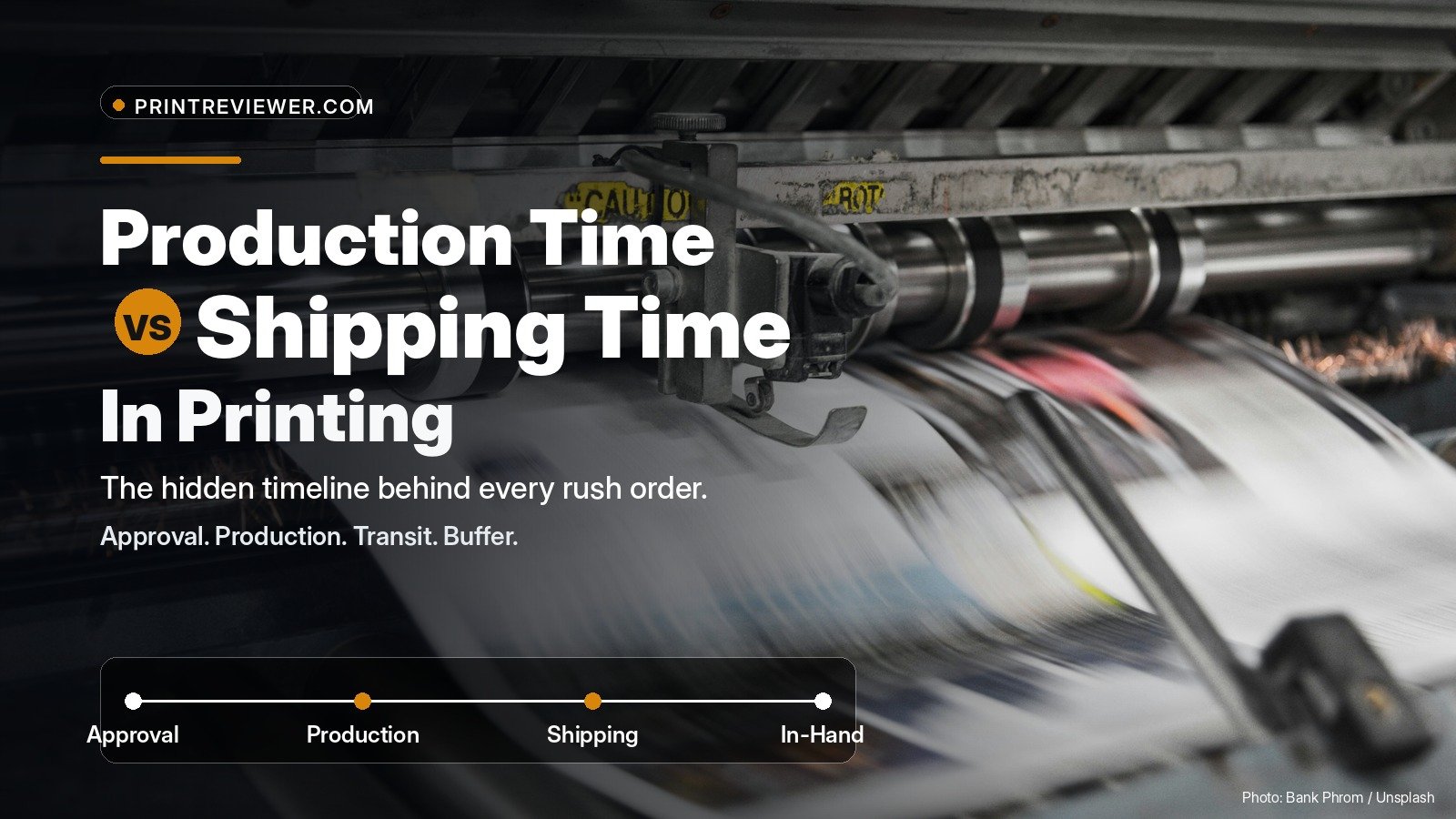
Production time vs shipping time in printing is one of those phrases that sounds painfully boring right up until your order arrives after the event it was meant for. Then it becomes very interesting, very fast. A lot of deadline mistakes happen because buyers collapse the whole print process into one fuzzy question: “How long will this take?” But production time vs shipping time in printing is really about two different clocks, and sometimes a third one hiding in the corner.
That third clock is approval.
If you understand where each clock starts and stops, a lot of online print timing suddenly makes sense. And a lot of “rush” claims stop feeling magical, which is healthy.
Why People Mix These Up
Print sites love fast language.
Same day. Next day. Rush. Express. Fast turnaround. Delivers by Tuesday.
None of that is automatically false. But it often mashes together steps that are not the same thing:
- file review and proofing
- production
- shipping
People see a delivery date and assume the job is already printing the minute they place the order. Sometimes it is not. Sometimes it is sitting in review. Sometimes it is waiting for proof approval. Sometimes the shop is ready, but the carrier still has the last word.
That is why production time vs shipping time in printing matters more than it first seems. You are not buying one blob of time. You are buying a sequence.
What Production Time Actually Means
Production time is the time the printer needs to make the order once it is truly ready to go.
That usually includes some mix of:
- prepress or file setup
- proofing or approval handling
- printing
- drying or curing, depending on the process
- finishing, like cutting, folding, laminating, binding, or packaging
- packing the order for shipment
This is the part people often think of as “the printer’s speed.”
And yes, it matters. A lot.
But production time is not just the moment ink hits paper. It includes the boring shop-floor stuff that still has to happen before a box can leave the building. If you order something simple, production may be fast. If you order a job with foil, lamination, die cutting, folding, or anything else with extra handling, that clock gets longer. Which is rude, but fair.
What Shipping Time Actually Means
Shipping time starts after the job is finished and handed off to the carrier.
That is a separate phase.
The printer can do its job quickly and the shipment can still take days in transit. Or the printer can take longer in production, then the carrier can get it to you overnight. These are not interchangeable.
Shipping time depends on things like:
- carrier service level
- distance
- business days vs calendar days
- cutoff times
- weather
- holidays
- whether the address is easy or annoying
Ground shipping is not the same thing as overnight air, and “ships tomorrow” is not the same thing as “arrives tomorrow.” That distinction is the source of a lot of entirely preventable sadness.
The Hidden Clock: Approval Time
This is the part people forget until it bites them.
A lot of online print jobs do not move fully into production until the files are approved. That may mean automatic approval, human review, digital proof approval, or some combination of those depending on the shop and product.
If the printer sends you a proof and you wait a day to review it, that day matters.
If they request a file fix and you need to reupload, that matters too.
And if the shop has a proof approval deadline or same-day cutoff, missing that can quietly push the entire schedule by a full business day. Not because anyone is trying to scam you. Just because production lines are scheduled around actual approvals, not hopeful vibes.
Why “Rush” Still Misses Deadlines
Rush production helps. But it does not erase math.
A rush order can still miss because:
- the file was not ready
- proof approval came in too late
- the order missed the shop’s cutoff
- rush production was selected, but standard shipping was left in place
- weekends or holidays reduced actual working days
- the product itself had finishing steps that still take time
This is where people get tripped up by language like “1 business day” or “same day.” Those claims often have conditions attached. If approval needs to happen before noon, and you approve at 2:15 p.m., your “same day” dream may become “next business day” reality.
And yes, that difference matters a lot more when you are ordering for a conference, wedding, trade show, launch, or other event where the clock is not forgiving.
A Simple Way To Read Print Timelines
When you are ordering online, do not just ask “How fast is it?”
Ask these instead:
When Does Production Actually Start?
Does the clock start when you place the order, when files upload, or when proof approval is complete?
Is Shipping Included in the Quoted Time?
Some sites talk about production only. Some show estimated delivery. Some blur the two together until you start reading the fine print like a disappointed detective.
Are Cutoff Times Real?
They usually are. If approval must happen by noon or 2 p.m. Eastern, that is not decorative text.
Do Weekends Count?
Often, no. “2 business days” sounds short until you order on Thursday evening.
Are Finishing Steps Included?
Foil, lamination, binding, die cutting, and specialty work can change the schedule even when the base print time looks fast.
The Safer Way To Plan a Deadline
If the printed item must be in your hands by a specific day, work backward.
Do not start with the production promise and assume everything else will sort itself out. Start with the in-hand date, then back up for:
- shipping transit
- production time
- proofing and file-fix time
- at least a little buffer for life being life
That last part is not technical. It is just wise.
If the event is Friday, your goal should not be “I think it should arrive Friday morning.” Your goal should be “I want this in hand before I start bargaining with the universe.”
The Short Formula
If you want the plain-English formula, here it is:
In-hand date = approval time + production time + shipping time + buffer
That is not the sexiest formula in the world. But it is a lot more useful than staring at a rush badge and hoping.
Final Verdict
Production time vs shipping time in printing is not a tiny technical distinction. It is the difference between understanding the schedule and just squinting at it.
Production time is the printer’s making time.
Shipping time is the carrier’s transit time.
Approval time is the hidden gate that often controls when production even starts.
Once you separate those three things, “fast turnaround” becomes much easier to read honestly.
And that tends to be cheaper than needing a panic reorder.